Vietnam Revolts

Vietnam RevoltsVietnam Revolts

1946

Ho Chi Minh tried repeatedly to enlist the aid of the Truman Administration for independence. His letters never received a response. The French government, with support from the US and Britain, attempted to reestablish its colony in Indochina. The attempted was doomed and would lead to disaster at Dien Bien Phu.

Time: Early War
Side: USSR
Ops: 2
Removed after event: Yes

As USSR

This card starts off very strong and quickly becomes worse and worse as the game goes on.  On Turn 1, before Thailand has been claimed, this is a superb headline and an easy way to grab the crucial battleground.  By Turn 3, or worse, the Mid War, your attention is probably elsewhere, since the US will probably already have taken Thailand.  If the US hasn’t overcontrolled Thailand because you don’t have access to it, this can be a nice way to sneak into Thailand with the China Card.

The bonus to Operations is quite nice, though there aren’t really that many ways to spend all those Operations in Southeast Asia, since you’ll rarely venture south of Thailand.  It does mean that if you plan on playing the card during the turn, you should headline it for maximum benefit.  It’s a good headline candidate because it’s strong enough to be meaningful, but it’s not the end of the world if it runs into Defectors.

Riku Riekkinen’s thoughts:

Vietnam Revolts is a very good headline, because it allows the USSR to instantly dominate Asia (in case the US tries to dump Asia Scoring on the headline).

There are 4 camps regarding headlining Vietnam Revolts on Turn 1:

1) Don’t do that.  Wait until DEFCON is 3, so that US can’t coup you out of there.  This might cost you Thailand, depending on whether the US is already in Malaysia when you play Vietnam Revolts.  You might still be able to flip Thailand with your +1 Ops and China Card, however.

2) Headline it and coup Iran AR1.  Now US can start a coup-counter coup routine in Vietnam, but it’s couping at a disadvantage due to Vietnam Revolts’ +1.  So the US is really looking to empty out Vietnam with a coup, which it has a 1/6 chance of doing so on each roll.

3) Headline it and play into Thailand & Laos/Cambodia. Now, if the US coups Thailand, you can coup it back at +1.  Even if the US empties Thailand, preventing you from counter-couping, you still have backup countries in Southeast Asia and can retake Thailand before the US.

Now, it’s generally agreed that couping Iran is the best move for USSR on Turn 1 AR1. However, if you’re playing with influence bids for the US, Iran is sometimes overcontrolled so heavily that couping Iran is no longer worthwhile.  This Vietnam Revolts headline play is a strong alternative, and probably much better than Socialist Governments & Italy.

4) Headline it and play Asia scoring on AR1, scoring a quick and dirty Domination.  Probably the worst of these options, but a possibility if you have a truly, truly terrible hand (e.g., nothing but 1 Ops after a Red Purge/Scare headline).

As US

Completely harmless if played on the final Action Round, so long as you make sure you already took Thailand (and possibly Laos/Cambodia).  This card is a good reason not to play into Vietnam unless you need the country immediately for Asia Scoring or Southeast Asia Scoring.

Posted in Early War, USSR Events | Tagged | 17 Comments

General Strategy: Reshuffles

In a typical game of Twilight Struggle, the draw deck will reshuffle while dealing out the cards for Turns 3 and 7.  Occasionally, the deck will reshuffle immediately before Turn 10 as well.

What this means is that cards can fall into one of several categories:

  • Any card played or discarded on Turns 1 and 2 will be guaranteed to be redrawn between Turns 3-7
  • Any card played or discarded on Turns 3-6 will not be redrawn until Turns 7-10
  • Any card played or discarded on Turn 7 or later will probably not be redrawn, and if it is, it would only be on Turn 10

Note that this is not a perfect overlap with when the cards come out:

  • All Early War cards are guaranteed to be drawn between Turns 1-3
  • All Mid War cards are shuffled in on Turn 4, and therefore are guaranteed to be drawn between Turns 4-7
  • All Late War cards are shuffled in on Turn 8, and will be drawn only on Turns 8-10 (if at all)

What does this mean strategically?  It means that when discarding your opponent’s vital events, you want to discard them on Turns 3 and 7, rather than on Turns 2 or 6.

This is most commonly applied to the two most important Early War events in the game: Decolonization and De-Stalinization.  They are far and away the most important cards to draw, even more important than Red Scare/Purge.  So as a US player, if I draw either or both in the Early War, I will do my best to hold onto them until Turn 3 before discarding them with Blockade, the Space Race, or UN Intervention.  This guarantees that they cannot be reintroduced to the deck until Turn 7 at the earliest.  If I sent Decolonization to space on Turn 2, by contrast, it could come back at Turn 3 at the earliest, and in any event not later than Turn 7.  It’s a huge difference that dramatically changes the dynamics of the game.

It is therefore very important to consider what cards you hold on Turns 2 and 6, because those held cards won’t be coming back into the game for a very long time (if at all).  For instance, if, as US, you are choosing between triggering the Voice of America event vs the John Paul II Elected Pope event on Turn 6, you should choose Voice of America, because it might come back again next turn, and hold John Paul.  It’s not a huge deal for John Paul to be played on Turn 7, since he can only happen once anyway.  Similarly, as USSR, if you are debating between playing Arab-Israeli War or Defectors for Operations on Turn 2, you should play Arab-Israeli War now and hold Defectors until Turn 3 so that you can have worry-free headlines between from Turns 3-6.

This also somewhat affects the Our Man in Tehran event, which is much more helpful on Turn 7 than on Turn 6.

Posted in General Strategy | 14 Comments

General Strategy: Events vs Operations

The overarching paradigm of Twilight Struggle is that events create opportunities, and Operations are how you take advantage of those opportunities.  Accordingly, you should treat events not as your primary source of influence, but rather as gamechangers that break open the game for your Operations.

The basis for this principle is the observation that Operations are generally more efficient than events, even if the event technically gives more influence.  The Comecon event gives the USSR 4 influence, but they’re spread out and in a rather useless place.  By contrast, the 3 Ops of the Comecon card can be played as a strong coup, can take over a crucial battleground, or can extend and create threats all over the board.

On the other hand, by the Mid War, many regions begin to degenerate into stalemates.  Once your opponent controls a country, it’s hugely inefficient to try to break their control with Operations alone.  Sometimes it’s still worth it, but you need to be at a significant Ops advantage (or take multiple Actions in a row) to take over an opponent-controlled country with pure Ops.  Alternatively, maybe you just don’t have access to the region: without coup targets, all the Operations in the world aren’t going to get the USSR into the Americas.

This is where events come in.  Their effects can have dramatic ramifications and shake up otherwise deadlocked regions.  USSR secure in Africa?  Boom, Nuclear Subs and all of a sudden all the battlegrounds are yours.  US is dominating Europe?  Bam, Socialist Governments headline, and now an AR1 Europe Scoring is -5 instead of +5.

A large part of Twilight Struggle skill is therefore recognizing which events to trigger, and when to trigger them.  Some events are so powerful that you will almost never see them played for Operations (ABM Treaty, Decolonization, Grain Sales to Soviets), and some are so awful you’ll never even remember their event text (Summit, Nuclear Test Ban).  But most events are somewhere in between.  Knowing when you should press on with your Operations and when you need to call upon an event is a hallmark of a strong player.

A good example is Red Scare/Purge.  The event text is unbelievably strong: it can cause your opponent to flat-out lose the game.  But while a weaker player will tend to automatically headline the card, seeing only the advantages and opportunities of -1 to your opponents’ Ops, a strong player will also spot the potential benefits of being able to play 4 Ops at once (one of only five Early War 4 Ops cards), and recognize when Red Scare/Purge ends up being more beneficial when played for Operations.

To get better at this differentiation, it is helpful to classify the cards in the game into four categories: your opponents’ starred events, your own starred events, neutral starred events, and recurring events.  With your own events, you are choosing between the Ops and the event; with your opponent’s events, you are choosing between the Ops minus the event effect or the Space Race.

Your opponents’ starred events

Your opponents’ starred events can only happen once in the game.  Prior to Turn 7, therefore, you should seek to trigger them whenever possible — better that you control its one-time effect than your opponent — rather than discarding them (by playing them on the Space Race, or by playing it with UN Intervention).  Some examples:

  • The US should always try to get Warsaw Pact Formed out of the way as soon as possible, since 5 influence for the USSR is infinitely preferable to the looming threat of being able to instantly remove all US influence in eastern Europe.
  • A US player that draws De Gaulle Leads France can play it with an empty France and then place the 3Ops into France to make it 3/1.  On the other hand, a USSR player that draws De Gaulle can headline it and then take France easily on AR1.
  • The USSR should play Containment and Nuclear Subs on the final Action Round of a turn, where they have the least effect, rather than send them to space only for the US to draw them back and play them more effectively.
  • Truman Doctrine is useless in the USSR hand, because the USSR can just play it as soon as they have no uncontrolled countries.  On the other hand, a US player can time its play for maximum effect, by, for instance, breaking USSR control of France on the final Action Round, and then headlining Truman Doctrine the next turn to wipe out 3+ USSR influence from a critical country.
  • Many beginner US players will find ways to discard or cancel Blockade from being played.  This is a mistake.  If you draw Blockade and can safely play, you should usually do so, rather than allow the USSR to spring a nasty surprise on you in the Mid War.

Only the truly critical opponents’ starred events, the ones you have no ability to manage, should be sent to space.  These include De-Stalinization, Tear Down This Wall, The Reformer, and Quagmire/Bear Trap.  These are usually either so strong, or so suicidal for you to play, that you would prefer to assume the risk of your opponent controlling how it’s played rather than play it yourself.

However, if you’re on Turn 7 or later, you no longer need to worry about the “removing” vs “discarding” distinction.  For all practical purposes, you can safely discard cards knowing they will almost certainly not return to the game.  The draw deck reshuffles on Turn 3 and Turn 7; it’s occasionally reshuffled on Turn 10, but that’s quite rare.  Of course, you still won’t be able to space every card you see, and will still have to deal with some of the events, but you no longer have to worry that cards sent to space will return to your opponent’s hand.

Your starred events

Most of these you want to keep around in the deck, since you would rather your opponent have a hand full of your events than full of his.  Sometimes the effect of a card is the same no matter who plays it: neither side particularly cares who triggers Willy Brandt or NATO.  (In other words, these are generally bad events.)  Sometimes a card is only dangerous because your opponent is playing it: CIA Created, for instance.  Sometimes the looming threat of the card is more effective than the card itself: Truman Doctrine‘s continued presence in the deck is often enough to deter the USSR from engaging in an influence war in Europe.

But there are also times when you must trigger your own starred events:

  1. Because they will be meaningless or crippled in your opponent’s hands: see, e.g., Containment/Brezhnev Doctrine, “Ask Not What Your Country…”, Cultural Revolution.
  2. Because they are so critical that your opponent will never play them for you, and certainly send to space: see, e.g., De-Stalinization and John Paul II Elected Pope.
  3. Because if you don’t play it now, its effect will be meaningless later: see, e.g., Vietnam Revolts and Puppet Governments.
  4. Because if you don’t play it now, it may never get played.  You really hope the USSR will draw CIA Created, but if you draw it on Turn 7 as the US, don’t hold out hope that the USSR will somehow draw it again by the end of the game.  Just play it if you need it.

Neutral starred events

There aren’t many of these.  Consider playing them so your opponent can’t.  This is especially true of SALT Negotiations: even if you can’t make good use of it, you don’t really want your US opponent using it to play The Voice of America again.

Recurring events

Since these events will trigger over and over again, you don’t have to worry about removing them from the deck.  So when playing neutral or your own recurring events, the general principle applies: do you really need the event?  Or are the Ops going to be better?  Latin American Death Squads maybe gives you one coup bonus, but the 2 Ops is almost certainly superior.  On the other hand, Liberation Theology is also 2 Ops, but it gives you 3 influence, can be played into US-controlled countries with no penalty, and is in a fairly critical region.  As US, Duck and Cover is usually played for the 3 Ops, but towards the end of the game, the 3VP / denial of a USSR coup may be worth considerably more.  (As a general rule, most of the neutral recurring events are pretty strong.  ABM Treaty, Brush War, Junta, and Red Scare/Purge are all among the best events in the game.)

There’s no real advantage to playing your opponents’ recurring events instead of spacing them.  The only relevant question, therefore, is whether it’s worth sending to space or using the Ops.  Since you ordinarily only have one Space Race slot per turn, you have no choice but to work around most of your opponents’ recurring events.

Generally, this is accomplished by triggering the event before playing the Ops (with exceptions: the US can preemptively defend against Arab-Israeli War with the Ops, for instance).  Socialist Governments and East European Unrest are not really problems when you can just replace the Influence lost.  But some don’t give you enough Ops to fix the problem: you’ll rarely be able to repair the damage done by Decolonization and The Voice of America, and so those are just going to have to go to space.  And certain cards are flatout irreparable: Grain Sales is a canonical example of a card the USSR must keep sending back to space instead of losing by thermonuclear war.
Posted in General Strategy | 7 Comments

Fidel

FidelFidel

1959

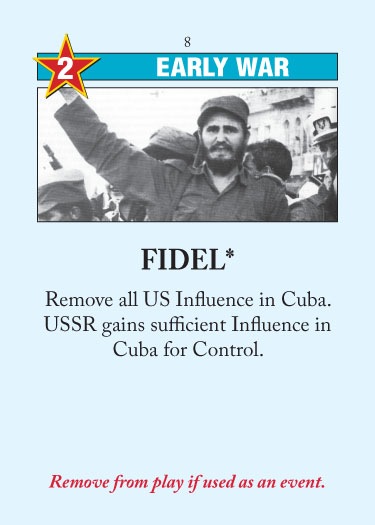
Coming to power after deposing the corrupt Batista, Castro disenchanted the US after it became clear he was leading a Marxist revolution. The US tried various schemes to depose or assassinate Castro, culminating in the disastrous “Bay of Pigs” invasion. Ultimately, communist Cuba would lend support to Marxist governments in Angola and Ethiopia.

Time: Early War
Side: USSR
Ops: 2
Removed after event: Yes

As USSR

One of the key routes into Central America.  Owning a battleground adjacent to the US (and 1/3 of the Central American battlegrounds) is worth quite a bit.  Coupled with a successful Panama coup and/or Liberation Theology, it can lead to an easy Central America domination.

On the other hand, playing Fidel too early can turn CIA Created into a DEFCON suicide card, if you don’t have any other influence in Africa or the Americas.  So it’s often best played for Ops on Turns 1 or 2 (unless you’ve already Decolonized or De-Stalinized into South America/Africa), and worth the event if drawn on Turn 3 or later.

At some point in the Mid War, it’s crucial to take Haiti and/or Nicaragua, as otherwise it’s very easy to realign you out of Cuba with no easy way back in.

As US

For the reasons above, on Turns 1 or 2, it’s probably better to use Fidel’s 2 Ops (in case the USSR drew CIA Created) than to send him to space only to see him return soon thereafter.  But if you draw him on Turn 3 or later, he’s worth sending him to space: by this point the USSR is going to have influence in the Americas or Africa anyway, and you might as well deny the USSR a free 2VP (or more) and foothold in Central America until at least Turn 7.  Whether you’re then willing to take Cuba depends entirely on whether you have Central America Scoring and your tolerance for risk.

If you do play Fidel for Ops and have the luxury of Ops to spare, you can try to realign Fidel out with the 2 Ops: you have a 34.88% chance of eliminating him entirely.  Your odds are of course greatly improved if you take Nicaragua (and maybe Haiti, with Puppet Governments), but then the USSR can just coup you out of those 1-stability countries before you get a chance to realign.  So if you’re keen on realigning Fidel, consider playing 1 into Nicaragua on a final Action Round and present the USSR with the dilemma of couping Nicaragua or couping a battleground next turn.

Posted in Early War, USSR Events | Tagged | 9 Comments

Regions: Asia

Asia ScoringAsia Scoring

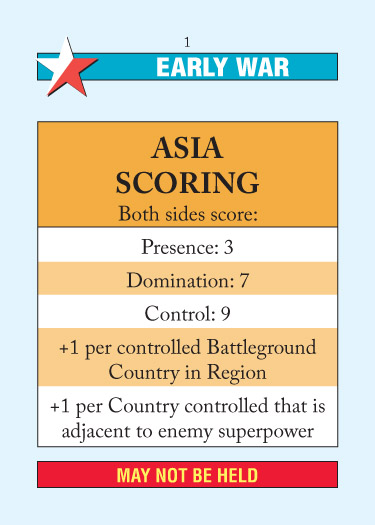
While Europe may have been the object of the Cold War, Asia was the battleground. From the Chinese Civil War, to the Korean War to Vietnam and Afghanistan, Asia was the place where the Cold War came closest to growing hot. For this reason, Asia is the second most significant region for scoring.

Time: Early War
Battlegrounds: 6
Countries: 15

General Considerations

The Early War (more specifically, Turn 1) is more or less a fight for Asia.  It’s difficult to get anything done in Europe, and the USSR enjoys several major advantages in the Middle East.  This leaves Asia as the one region the two sides will clash over most.  Whoever comes out of the Early War with Asia domination will likely keep it for the rest of the game, though the omnipresent threat of the China Card keeps Asia very much hanging in the balance.  The fact that it can’t be couped at DEFCON 3 means that the US will often make a control-breaking play in Asia on the final AR of a turn, so on the next turn, the USSR is forced to choose between its battleground coup or repairing the damage in Asia.

Early War

The key to Asia lies in the very first Action Round of the game — the Iran coup.  If the USSR is able to rid Iran of US influence before the US has a chance to spread into Afghanistan or Pakistan, then the only question is whether the USSR is also able to grab Thailand or South Korea and therefore score domination.  But if the USSR is unable to keep the US out of Iran, then the tables are turned, and it is the USSR that must successfully defend both Thailand and South Korea to prevent the US from dominating Asia.

In other words, whichever side comes out of Iran by the end is likely going to be able to take Pakistan and India.  The USSR starts with North Korea, and the US has de facto control of Japan.  Accordingly, South Korea and Thailand are the keys to Asia, and are therefore much of the focus of Turn 1.  The US has easier access to these countries, but the USSR will look to make use of the Korean War, Vietnam Revolts, and Decolonization to even the playing field.

The one wild card in all of this is the Indo-Pakistani War, which can dramatically change western Asia.  Skilled players that suspect an Indo-Pakistani War will make sure to shore up Pakistan’s and India’s neighbors before committing to Pakistan and India entirely.  But you won’t always have the tempo to do all of this before Asia Scoring, and India in any event can never be entirely safe from the War.

As the US, it is also possible to deny domination to the USSR by grabbing all the cheap countries and ending up with a higher overall country count.  As there are 15 countries on each side, the US only needs to grab 7 countries in addition to Australia to guarantee that it cannot be dominated, even if it loses the battleground war 4-2.  This is easily achieved if you take Thailand and its neighbors in Southeast Asia, and possible (though unlikely) if the USSR took Thailand.

Formosan Revolution can sometimes turn the tide in favor of the US, but it’s only relevant if the two sides split the battlegrounds 3-3 and Asia Scoring triggers before the US uses the China Card.  It is generally a harmless 2Ops for the USSR and not worth the event for the US.

Mid War

In the Mid War, several important Asian events enter the deck.  Southeast Asia Scoring raises the stakes, and the China Card cards (Nixon Plays the China Card, Ussuri River Skirmish, and Cultural Revolution) all make their presence felt.  Of these, Ussuri is easily the most influential; although it’s not very important if the US is already dominating, it can quickly turn USSR domination into US domination when followed up with the China Card.

On the whole, however, the Mid War is mostly a fight for the new regions: Africa and the Americas.  By this point, Asia is frequently already locked down, and you need a gamechanger (Brush War, Red Scare/Purge, Ussuri River Skirmish, or the China Card) as well as high Ops cards to make any headway.  Nevertheless, Asia is sufficiently high-scoring that it’s probably worth overcontrolling your key battlegrounds as a prophylactic measure against such gamechangers.

The fact that there is an even number of battlegrounds means that it is very difficult to flip your opponent’s Domination into your Domination.  Therefore, Asia tends to be most contested when neither side exits the Early War with Domination.

Shuttle Diplomacy is generally less helpful than it appears.  The reason is that the USSR typically leads in battlegrounds 4-2, in which case the saved battleground is rather meaningless.  However, if the battlegrounds are split 3-3, then Shuttle Diplomacy can be a nice one-time domination if the US has enough countries overall.  It is essentially an uncertain 5VP card, depending on the board, how the USSR responds, and which scoring card triggers first.  Although it’s not much of a big deal for the Middle East, it can be rather more potent in Asia.

Late War

No Late War event explicitly targets Asia.  (Soviets Shoot Down KAL-007 gives the US an outstanding headline if they control South Korea, but doesn’t necessarily help them in Asia.)  Although it is possible for Asia to flip from one side to another, in practice, at this point Asia is just as locked down as it was through the Mid War.  The China Card (and its associated events) continue to ensure that Asia is never entirely decided until the end of the game, but Asia is generally the least volatile region in the Late War.

Posted in Early War, Neutral Events, Regions | Tagged | 6 Comments

Socialist Governments

Socialist GovernmentsSocialist Governments

1947

Beginning with the end of the Second World War, the US was challenged by democratic leftist movements within its sphere. Italy, under de Gasperi, was particularly contentious with communists and socialists participating in government. The CIA funded an extensive propaganda program against these movements. Socialist governments would be the topic of concern again during the 1960s in France, and with left-wing labor party in the UK.

Time: Early War
Side: USSR
Ops: 3
Removed after event: No

As USSR

An all-around excellent headline throughout the game.  If you don’t have other Headline-AR1 combinations, a Socialist Governments headline can be followed up with just about anything on AR1: you can take over a European battleground, you can score Europe on hugely advantageous terms, or you can simply to take one out of the UK or Canada so that Special Relationship and NORAD, respectively, don’t trigger.

On Turn 1 in particular, a Socialist Governments headline can cripple the US position. It is one of the few headlines that can make an opening Italy coup worthwhile, since if you’re going to give up western Asia, you better at least do some serious damage in Europe to make up for it.  The very threat of a Socialist Governments headline also keeps the US opening setup honest, since it essentially compels the US to overcontrol Italy.

If nothing else, the Socialist Governments headline is a useful distraction; if you can remove three important influence, then even if you don’t play into Europe on AR1, the US will usually be scrambling to fix the situation on their AR1.  Later in the turn, it’s not quite as helpful, and you’re usually better off using the 3Ops or holding it for next turn’s headline.

As US

Typically either played for Operations (to replace the influence lost), or simply played on the Space Race (especially if under Red Scare/Purge).  Either way, it’s an empty Action Round, but at least it’s usually not a problem to deal with; be thankful you drew it and not the USSR.  If you are not careful, you aren’t always able to replace all your Influence (e.g., if you had 2 in Greece and 1 in Turkey, and let Socialist Governments trigger first, you may no longer have access to Turkey to replace its influence).

Somewhat takes away the sting of a USSR play of The Iron Lady, which is technically a US event but in practice far more useful for the USSR.

Posted in Early War, USSR Events | Tagged | 1 Comment

Battlegrounds: Thailand

Experienced players know that the road to Asian domination begins and ends in Thailand. Assuming that the USSR keeps Pakistan, India, and North Korea (generally safe assumptions in the Early War), the US needs both South Korea and Thailand to stop Asian domination.  (Japan is never really contested by the USSR.)  These countries share the common characteristic of being the only Asian battlegrounds that both sides will have reasonably easy access to in the Early War.

Unlike South Korea, however, Thailand is much easier to flip, especially with the China Card.  Overcontrol is a must against a player with the China Card, because 5Ops can flip a 2/0 country into 2/4.  (For the US, sometimes double overcontrol is needed against China + Vietnam Revolts.)  Even 3/0 turns into 3/3 after the China Card.

Thailand is usually taken on Turn 1.  There are some complications involving DEFCON, but generally both sides are keen to get to Thailand as soon as possible.  In the Mid War, Thailand’s low stability combined with Southeast Asia Scoring makes it a frequent target for influence wars (and Brush War!), and whoever flips Thailand is often able to flip the Asia scoring card to their advantage.

As USSR

The easiest way to get to Thailand is with Decolonization or Vietnam Revolts.  With Decolonization, you must be wary that you don’t just get immediately couped out of Thailand.  On the other hand, if you coup DEFCON to 3, even with Decolonization, you won’t be able to stop the US from taking Thailand first.  If DEFCON is still at 4 on Turn 2, you can headline Decolonization into Malaysia and then reinforce it so that the US never even has access to Thailand, later securing Thailand at your leisure.

With Vietnam Revolts, you’re a bit safer, as your +1 to Ops in Southeast Asia means that it’s difficult to coup you out of Vietnam.  When DEFCON drops to 3, you’ll be able to take Thailand first, and in any event a 6Ops China Card will be difficult for the US to defend against.

De-Stalinization can also place influence into Thailand, but this is strictly a desperation move: De-Stalinization is in general fairly weak on Turn 1, and especially weak if you are wasting 25-50% of it in Southeast Asia.

Without these events, your best bet for Thailand is to crawl across Asia (assuming the US doesn’t expose itself to being couped in Southeast Asia).  You are thus very unlikely to gain control of it on Turn 1.  Nevertheless, Vietnam Revolts will eventually come out and guarantee you access to Thailand; you can fight for it then.

As US

The US is usually able to get to Thailand first, because you need no events in order to get into Thailand: you can just walk right through Malaysia.  Generally, you try to wait until DEFCON drops to 3 lest you get couped right out of Malaysia.  It is equally critical to play into Malaysia as soon as DEFCON drops to 3, because if you wait a turn, you allow the USSR to play Vietnam Revolts/Decolonization and then take Thailand while you are still in Malaysia.  If you do get Thailand taken from you, play into Malaysia to ensure access to this critical battleground, and consider using your AR6 play to break Thailand control so that the USSR is forced to choose between shoring up Thailand and couping on his next Action Round.

After securing Thailand, it is important to sooner or later take Malaysia and Laos/Cambodia so that Thailand is not an automatic target for Brush War in the Mid War. And since the USSR starts with the China Card, you absolutely need to overcontrol Thailand so that the China Card doesn’t just flip the country.  Even if the USSR doesn’t immediately have access to Thailand, he will sooner or later, and you don’t want to be caught off guard by a Vietnam Revolts headline followed up with the China Card to steal your Asian Domination.

Affected by:

  • Brush War
  • Southeast Asia Scoring
  • The China Card
  • Decolonization / Colonial Rearguards
Posted in Battlegrounds | Tagged | 6 Comments

General Strategy: DEFCON

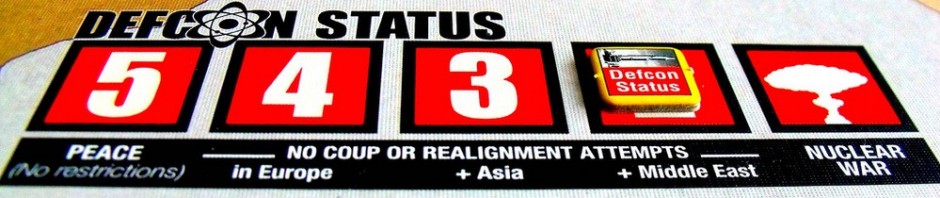
One of the most important rules in Twilight Struggle is that you lose the game if DEFCON drops to 1 on your turn.  It doesn’t matter who “caused” it: if it happened on your watch, you’re responsible for humanity’s destruction.

It’s a very important rule because it ties directly into the paranoia and brinksmanship of Cold War doctrine.  In most games of Twilight Struggle, DEFCON is deliberately kept at 2 nearly all the time.  Coups in battleground countries are so vital that both sides naturally gravitate towards DEFCON 2.  Generally this means that the USSR is more than happy to get the one battleground coup per turn, and keep DEFCON at 2 otherwise.

The cost of this brinksmanship is illustrated through several cards that are deliberately designed to degrade DEFCON by one level.  With DEFCON at 2, these cards become “DEFCON suicide cards” and unplayable.

Loosely speaking, there are four categories of cards that can cost you the game.

Cards that unconditionally degrade DEFCON

You can never trigger these events on your turn when DEFCON is at 2.

Cards that allow your opponent to conduct Operations

You can never play your opponent’s events from this list on your turn when DEFCON is 2 and your opponent can drop DEFCON by couping a battleground of yours (keeping in mind DEFCON restrictions).  So if the US has any influence in a battleground in South America, Central America, or Africa, Lone Gunman is unplayable.  Similarly, the USSR can play CIA Created at DEFCON 2 safely in the Early War only if they have no influence in Third World battlegrounds.  This is one reason why playing Fidel is not such a big deal for the US in the Early War, since it makes CIA Created unplayable.

Practically speaking, these cards are indistinguishable from unconditional DEFCON degraders.  Only CIA Created comes out early enough such that the USSR might not have any Third World influence; by the time Lone Gunman and Grain Sales arrive, you would already be far behind if you have no influence in battlegrounds in South America, Central America, or Africa.  In truly extreme situations, you might be able to eliminate yourself from those regions preemptively in order to play one of these cards.

Note that Tear Down This Wall is also included in this category, because it allows a coup Europe despite DEFCON restrictions.  Although it is theoretically possible that the USSR has no influence in any European battleground, they may as well resign anyway if that’s the case.

Cards that have a chance of degrading DEFCON

  • Five Year Plan (Early War, US 3Ops)
    • If played by the US, can pull Soviets Shoot Down KAL-007 or Duck & Cover. If played by the USSR, can trigger any of the other cards on this list in the USSR’s hand.
  • Missile Envy (Mid War, Neutral 2Ops)
    • Although this event won’t trigger any of your opponent’s events, it can still pull any your own unconditional DEFCON degraders.  Many a US player has played this at DEFCON 2 only to be handed Duck & Cover.  It can also cost you the game if it pulls one of the neutral DEFCON degraders, though the chance of Summit being the highest Ops card in your opponent’s hand is quite small.
  • Ortega Elected in Nicaragua (Late War, USSR 2Ops)
    • Only unplayable for the US if it has influence in Cuba.
  • Star Wars (Late War, US 2Ops)
    • The USSR will lose if it plays this while the US is ahead in the Space Race, and any of the other cards on this list is in the discard.  (Including USSR events like We Will Bury You.)

Neutral events that degrade DEFCON

These are not really a problem, since you would have to be daft to play either of these for the event at DEFCON 2.  Simply play them for Operations and you won’t lose the game.  The only way these can really cost you the game is if you pull them with Missile Envy.

Managing these cards

At its heart, Twilight Struggle is a game about managing crises.  So how do you manage these crises?  Obviously, it’s easy to deal with neutral events and your own events (just don’t play Olympic Games for the event at DEFCON 2!), but how do you dispose of your opponent’s events without losing the game?

The easiest way is the Space Race.  Virtually every card on this list can be sent to space.  On the other hand, you can usually only space one card per turn, and in the case of CIA Created / Lone Gunman, you can’t space those unless under the effects of Brezhnev Doctrine / Containment.   And if you’re under the effects of Red Scare/Purge, your hand suddenly looks a lot more dire.

So sometimes you won’t be able to Space Race a card.  At that point, you might want to consider holding the card until next turn.  If you have the China card, this is considerably easier; if you play the China card, you can even hold two cards.  (SALT Negotiations also helps you hold one more card.)  If you don’t have the China card, this becomes a very risky proposition: you’re quite vulnerable to any handsize reduction.  A USSR play of Blockade, Terrorism, or Aldrich Ames Remix, or a US play of Five Year Plan, Grain Sales to Soviets, or Terrorism can cost you the game.  Even your own play of UN Intervention can lose you the game, and boy will that be an embarrassing way to lose.

Speaking of which, UN Intervention is also a natural solution to this problem.  It’s probably better to use UN on one of these cards than on, say, The Voice of America, since even though Voice of America is going to hurt, losing the game hurts more.  On the other hand, you won’t always draw UN Intervention, and playing it will cut your handsize, a problem if you have multiple such cards.  And the cards that you most want to use UN Intervention on — CIA Created and Lone Gunman — will just get reshuffled back into the deck if you don’t trigger the event.

With some foresight, you can also headline the card.  Usually the USSR is unwilling to lower DEFCON during their headline, so it’s generally safe for the US to play a DEFCON-lowering headline.  USSR can likewise wait until AR1 to play cards like CIA Created, since US headlines generally trigger first, and this way you can play something else if the US lowers DEFCON to 2 during headline phase.  Of course, this solution isn’t guaranteed safe as your opponent’s headline may drop DEFCON first, and CIA Created / Lone Gunman are deliberately designed for maximum hurt when played in the headline phase.

More rarely, you can use events to help you get out of the jam.  Nuclear Test Ban and SALT Negotiations both raise DEFCON by two levels, so even if your opponent drops DEFCON in response, you’ll still be able to play your cards at DEFCON 3.  Cuban Missile Crisis will stop your opponent from couping anywhere in the world (and it takes precedence over victories by DEFCON), but it’s easily cancelled, so it usually doesn’t work.  Brezhnev Doctrine and Containment allow you to send CIA Created and Lone Gunman to space.  As USSR, you can take advantage of Nuclear Subs to stop US coups from dropping DEFCON.  As US, Ask Not What Your Country… can discard any of these cards, and Aldrich Ames Remix (if played as your last Action) discards your last card.  And of course, if you are sufficiently advanced on the Space Race track, you can discard your held card.

Posted in General Strategy | Tagged | 25 Comments

General Strategy: Turn 1

The first turn of Twilight Struggle is arguably the most important one.  An empty board means that the board is rife with both opportunity and pitfalls.  Even the smallest mistake early on can have dramatic ramifications: misplaying into Asia on Turn 1 can easily cost you Asia domination for the rest of the game.

As USSR

There are five great USSR headlines on Turn 1: Red Scare/Purge, Suez Crisis, Arab-Israeli War, Socialist Governments, and Vietnam Revolts.  The benefits of Red Scare/Purge are obvious.  Suez Crisis (and Arab-Israeli War, with a 50% probability) plus a successful Iran coup will wipe the US out from the Middle East entirely.  Socialist Governments allows you to make a strong play for Europe.  Vietnam Revolts provides you with immediate access to Thailand and all but guarantees you’ll be able to take it before the US does.

On AR1, you realistically only have two options: coup Iran, or coup / play for Italy.  Traditionally, USSR players made a play for Italy, but modern Twilight Struggle thinking is that access to Pakistan and India is simply too important.  The Iran coup is critical not just for the Middle East, but also to secure western Asia against the US.  Letting the US into Iran means letting them into two Asian battlegrounds, and makes it very difficult for you to prevent Asian Domination.

As far as the rest of the turn goes, you have several priorities.  In Europe, it’s usually difficult to break through to France, so you can only content yourself with nabbing Greece/Turkey.  In the Middle East, an early Nasser can net you both Egypt and Libya, and if the US is still in Israel, taking Jordan and/or Lebanon puts some real pressure on the US position.  Their only option for presence would then be an Israel incredibly vulnerable to Arab-Israeli War.  In Asia, assuming you successfully took Iran, you want to expand eastward from western Asia (while watching out for the Indo-Pakistani War), while for keeping alert for an opportunity to grab South Korea and Thailand.  Obviously Decolonization and Vietnam Revolts will help greatly with the latter.

As US

Assuming the USSR takes Iran, you have quite a few priorities:

  1. Protect Israel via Lebanon and/or Jordan.
  2. Make your way through Egypt into Libya before Nasser wipes you out.
  3. Gun for Thailand via Malaysia.
  4. Shore up South Korea while guarding against the Korean War.
  5. When you have a chance, take Greece and Turkey before the USSR does.

If the USSR opening coup of Iran is too good, then I wouldn’t bother dropping DEFCON to 3 by couping Iran back.  You not only risk being couped back if you succeed, but the USSR may be able to take Thailand first with Decolonization if you don’t succeed.  On the other hand, if the coup was weak, then I’m willing to gamble on the Iran coup in hopes of getting something into western Asia.  Overall, I’d much rather have the last coup of the turn than the second-to-last.

On the whole, your goal should be to survive rather than triumph.  All of the initiative is with the USSR; your main objective is simply not to fall behind too much in board position and VPs.  You should accept the fact that you will almost certainly be behind in VPs at the end of the Early War.  That’s OK, so long as you aren’t losing in every region.  Recognize when one region is beyond repair with just Ops, so you can cut your losses and be content to tread water there until you are able to take advantage of a major event to shake things up.

Posted in General Strategy | 36 Comments

General Strategy: Opening Setup

Each side begins the game with the ability to place Influence in Europe.  (Note that this is Influence, not Operations points for influence.)  The USSR can place up to 6 in Eastern Europe, while the US can place 7 in Western Europe.

As USSR

The standard opening setup for the USSR is 4 East Germany, 4 Poland, 1 Yugoslavia.  There is rarely any reason to deviate from this setup.  As USSR, you overcontrol your two battleground countries, vulnerable to East European Unrest and Mid/Late War events. Your 1 influence in Yugoslavia provides you with access to Italy, keeping your options open, as well as Greece.  Occasionally, you will see people play into Bulgaria, as it also provides access to Greece and is the only Eastern European country inaccessible from the rest of Eastern Europe.  But it does not provide access to Italy.

Alternatively, the “Comecon Trap” setup is 3 East Germany, 4 Austria, 2 Yugoslavia.  You headline Comecon, gaining you control of Austria and Yugoslavia.  (You can also do this with Warsaw Pact Formed, but Warsaw Pact is a critical card for the USSR in the Late War.)  On AR1 of Turn 1, you are now able to realign West Germany and Italy at +1.  Against a standard US setup, if you are successful, you can obliterate the US position in Europe in a single play.  However, this gambit is risky: not only are you not couping Iran (thereby allowing US unfettered access to western Asia), but it can be easily thwarted by a US headline of Defectors, Truman Doctrine (if they played enough into Austria), Duck and Cover, or even Marshall Plan.

As US

The standard opening setup for the US is 4 West Germany, 3 Italy.  As USA, you take the two safest battlegrounds in Western Europe, and the overcontrol of Italy guards against a Socialist Governments headline and/or T1 Italy coup.

If you have Marshall Plan in your opening hand and plan to headline it, you can open with 3 West Germany, 2 Italy, 1 Greece, 1 Turkey.  You still end up with the same 4/3 in West Germany and Italy, but you get two of the three critical Mediterranean non-battleground countries (the only two that the USSR has easy access to) and make it very difficult for the USSR to ever score Domination against you.

There are several reasons why you may want to leave West Germany empty.  For example, you fear Red Scare/Purge + Blockade, when you have no cards to discard, or alternatively, you hold both Blockade and De-Stalinization in hand and want to play Blockade without discarding any card this turn (so that you can hold De-Stal through the reshuffle).  In such situations (assuming you lack Marshall Plan), you can open with 4 Italy, 1 Greece, 1 Austria, 1 Turkey.  This guards Italy against Socialist Governments followed by a coup or Duck & Cover, provides an additional adjacency to Italy in case Socialist Governments removes adjacency to Italy and you get couped out, and provides access to West Germany so that you can threaten to take it immediately.

Posted in General Strategy | 73 Comments