 Middle East
In 1946, Truman had to threaten to send warships to the Mediterranean to compel the Soviets to remove troops from Iran. Thus began the Cold War struggle in the Middle East. Since this region provided Western economies with their lifeblood—oil—it also provided the USSR with an irresistible opportunity to meddle. US support for Israel gave the Soviets an opening to the Arab world that they would repeatedly exploit.
Time: Early War
Battlegrounds: 6
Countries: 10
General Considerations
The Middle East is the only region on the board that is consistently biased towards one side throughout the game. By design, the USSR almost always has the advantage in this region, amplified by the fact that OPEC is a de facto extra Middle East scoring card. It is quite rare for the US to score Domination: usually the primary goal is simply to prevent a USSR Domination (or worse, Control).
Early War
Four things will define the Middle East in the Early War:
1) The USSR Turn 1 headline: if the USSR can headline Suez Crisis (or Arab-Israeli War with a 50/50 shot), it can knock out the US base in Israel and cut off most US access to the western half of the region.
2) The Iran coup: this almost always goes the way of USSR. With a Suez Turn 1 headline, the US would be lucky even to get Presence in the Middle East. If the US is knocked out of Iran but can stay in Israel, the US has a fighting chance to avoid Domination if it can mitigate …
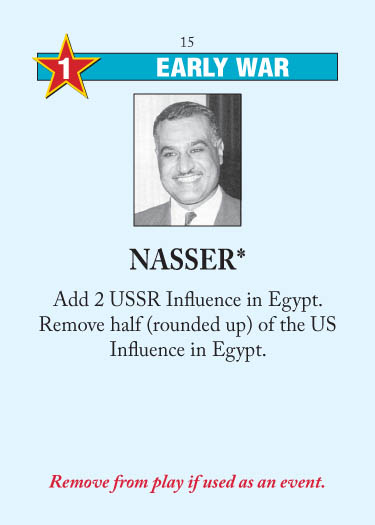
3) Nasser, which really determines the outcome of two Middle East battlegrounds, since Egypt is the only meaningful Early War path to Libya.
4) Also important are Jordan and Lebanon. Both of them mitigate Arab-Israeli War, and Jordan more importantly is usually the only US route into Iraq/Saudi Arabia.
What usually ends up happening is that the US is out of Iran but finds a way to get presence in the west, either with just Lebanon, or by making its way over to Jordan or Libya. Occasionally, the US can hang onto Iran and possibly score a quick and dirty Domination if they also take Lebanon. The flip side of that scenario is that the US loses both Iran and Israel, and is forced to coup in just for Presence.
Either way, the best the US can hope for is usually just escaping the Early War having stopped USSR domination.
Mid War
Muslim Revolution is the great specter looming over the Middle East in the Mid War. If the US had been counting on Iraq and Saudi Arabia, that’s six seven influence lost and irreparable with a single play. In addition, if the US had relied on Libya and/or Egypt, there’s a very real possibility the US can’t get back into either country if it has no adjoining influence in Israel or Tunisia. OPEC just kicks the US while they’re down, essentially equivalent to a Domination scoring for the USSR only. Accordingly, the US will be desperate to send either or both off to space.
The sole ray of light for the US is Egypt, where Sadat Expels Soviets and Camp David Accords can undo the effect of Nasser. Since Sadat in particular is a 1Op card, it’s very difficult for the USSR to mitigate or discard on the Space Race, and is therefore almost certain to happen at some point during the Mid War.
Shuttle Diplomacy is generally less helpful than it appears. The reason is that the USSR typically leads in battlegrounds 4-2, in which case the saved battleground is rather meaningless. Even if the battlegrounds are split 3-3, Shuttle Diplomacy does not usually give the US domination unless the US has enough countries overall. It is essentially an uncertain 3VP card at best, and so the US will usually not play it for the event barring special circumstances. Of course, if the USSR plays Shuttle Diplomacy (and it usually will, since there are far worse US events to be sending to space), then there is no reason for the US not to take advantage of it.
Generally, the USSR will keep some combination of Iran, Iraq, and Saudi Arabia (optional). As long as they can take (or hang onto) one of the western Mideast battlegrounds (often Egypt/Libya, sometimes Israel), they should score an easy Domination. Control is difficult but not entirely out of reach.
The US goal is to survive. This is much easier if they had already stolen Libya in the Early War: so long as Sadat comes out before Middle East Scoring, they only need one more battleground to stop Domination.
Late War
Muslim Revolution and OPEC are likely to strike again, but this time can be prevented with AWACS Sales to Saudis and North Sea Oil, two mediocre events made somewhat good by their indirect effect on the Middle East. Nevertheless, the USSR is likely to continue dominating the region, one of their few bright spots in a world tilting heavily towards the US. Iranian Hostage Crisis, Marine Barracks Bombing, and maybe Iran-Iraq War add a little fuel to the fire, but generally they only slam the door shut on the US rather than leading to any cataclysmic change in the region.



 Twilight Strategy