Regions: Europe

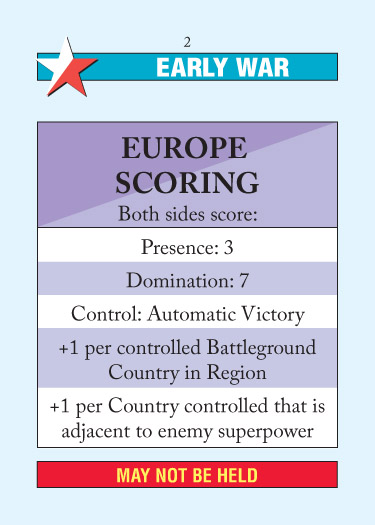
Europe ScoringEurope Scoring

Some Cold War historians view the entire struggle, costing millions of lives, untold trillions of dollars, and conflict around the globe, as a struggle for the future of Germany. While that view may be too myopic, it is clear that Europe always remained in the forefront of strategy and emphasis. Defeat in Europe ultimately meant defeat in the Cold War.

Time: Early War
Battlegrounds: 5
Countries: 21

General Considerations

Although it is the highest-value region on the board, Europe is rarely one of the highest-scoring regions.  It is unusual for either side to earn anything other than 1VP or 5VP from Europe Scoring; high stabilities and DEFCON restrictions means that it is one of the most difficult regions to break through.  Only in the Late War does the situation change, thanks to a slew of powerful US events that dramatically reshape the European battlegrounds.

Despite the immense reward of Europe control, it is in practice rarely seen.  The Ops investment needed is huge, and a player that singlemindedly focuses on Europe usually ends up sacrificing the rest of the world, potentially even losing to autovictory before Europe scoring is played.  So if your opponent starts to make a push for Europe, and you can’t defend your position (because you’re under Chernobyl or Red Scare/Purge), give some serious thought to giving up Europe Control in exchange for the rest of the world, and aim to win the game before Europe gets scored.

Early War

Each side typically starts with “their” battlegrounds: East Germany and Poland for the USSR; West Germany and Italy for the US.  The USSR is sometimes able to alter this situation early on: for instance, a successful Turn 1 Comecon Trap /  Italy coup, a successful Blockade, or a well-timed Socialist Governments can all allow the USSR to score a relatively easy Domination from just East Germany and Poland.

These considerations aside, Europe Domination tends to depend on two things: who controls France, and who controls the 2-stability Mediterranean countries.  US players are generally hesitant to play into France before Suez Crisis and De Gaulle Leads France are played, since they can cripple the US position.  At the same time, without De Gaulle, the USSR is unable to play into France without either spending 2 Ops for 1 influence in West Germany or Italy first, or playing Decolonization into Algeria.

The 2-stability Mediterranean countries are critical, because the odd number of battlegrounds means that one side will be able to score Domination unless the other side has more countries overall.  All of the other non-battlegrounds in Europe are significantly more expensive, though the US is slightly better positioned in this fight (with the aid of Canada, the UK, and Independent Reds).

Mid War

At this point, Europe tends to be the most static region on the board.  If Truman Doctrine has already been triggered, the USSR is sometimes willing to engage in an Ops war for France.  Italy can sometimes be the target of Brush War, but with some preparatory investment in its neighbors, your opponent will generally look elsewhere with his Brush War.  John Paul II Elected Pope will play a crucial role for the US, but he is primarily a springboard for the US in the Late War, rather than an agent of immediate change.

Late War

Unless the USSR has already established a dominant position in Europe, it will have a very difficult time in Europe in the Late War.  Although The Reformer can provide some help, it pales in comparison to Tear Down This Wall, Chernobyl, Solidarity, and East European Unrest.  With Chernobyl, the US will often sacrifice the rest of the board in pursuit of Europe control, but it must be careful of autovictory and/or Wargames!  The one beacon of light for the USSR is Warsaw Pact Formed, as it can singlehandedly wipe out all of the US work in Eastern Europe.  It is therefore critical for the US to trigger Warsaw Pact as early as possible, removing it from the game, so that it cannot come back as a much stronger card in the Late War.

Posted in Early War, Neutral Events, Regions | Tagged | 7 Comments

Five Year Plan

Five Year PlanFive Year Plan

1946-1950

Beginning in the 1920s, the Soviet Union became obsessed with centralized planning of its economy and industrial development. Twelve such plans were adopted by the USSR during its history. While economists differ, it is largely agreed that these plans caused more dislocation within the Soviet economy than they resolved.

Time: Early War
Side: US
Ops: 3
Removed after event: No

As USSR

One of two excellent Early War US events for the USSR, the other being Duck and Cover.  By playing it on your last Action Round, you can discard the one remaining card in your hand, which, conveniently, happens to be a scoring card for a region that you don’t want to score.  This is the only way for the USSR to get rid of a scoring card without playing it.

Even if you aren’t using Five Year Plan to discard scoring cards, its discard can be timed to  mitigate the effect of a low-Op US event.  For instance, OAS Founded is a hugely problematic card for the USSR because you only have 1 Op to deal with the 2 US influence it places.  But by playing Five Year Plan when you only have OAS Founded left, you are now able to respond with 3 Ops instead of just 1.  Similar tricks can be performed with most of the other annoying US 1 Op cards (e.g., Sadat Expels Soviets, Truman Doctrine, etc.).

On the other hand, Five Year Plan can be a serious liability in a hand of DEFCON suicide cards.  Either you risk playing it early on (hoping the US doesn’t draw one of the suicide cards), or you’re forced to treat it as yet another unplayable card in your hand.

As US

Almost always played for operations.  Occasionally played for the event: one possibility is that you know that the USSR is trying to hold a DEFCON suicide card, and by cutting their handsize (perhaps in conjunction with other handsize-reducers like Grain Sales to Soviets), you can force them to play it and lose.  If you’re able to hold onto the China Card and play several discarders against your opponent, you might be able to force a DEFCON victory.  Alternatively, if you’re desperate, you might play it in hopes of drawing an otherwise game-ending card like Wargames or an unfavorable scoring card.  In the Early War, with excellent card knowledge, you may be able to force out De-Stalinization or Decolonization if you are fortunate.  The event is also more attractive while under Red Scare/Purge, since it slows the USSR down at the cost of only 2 Ops.

Otherwise, you should always play this for operations.  3 Ops is quite valuable in the Early War for the US, and moreover, playing Five Year Plan risks drawing Duck and Cover and losing the game by thermonuclear war.

Posted in Early War, US Events | Tagged | 25 Comments

Duck and Cover

Duck and CoverDuck and Cover

1950

The US Congress passed into law the Federal Civil Defense Act, in reaction to the first Soviet tests of nuclear weapons in 1949. Duck and Cover is perhaps the most memorable of a variety of civil defense efforts to raise awareness of nuclear attack. Ironically, such films may have assisted in increasing the possibility of nuclear war by making the possibility of such a conflict “thinkable” by the general public.

Time: Early War
Side: US
Ops: 3
Removed after event: No

As USSR

One of two excellent Early War US events for the USSR, the other being Five Year Plan.  As the USSR, you will frequently find yourself in a position where you want to  simultaneously place influence but also drop DEFCON down to 2 to prevent an American battleground coup.  For instance, you can headline De Gaulle Leads France, and then follow it up with Duck and Cover to take France while simultaneously dropping DEFCON down to 2.  If you had instead used some other 3Ops card, the US would at least be able to respond by couping one of your battlegrounds.

Alternatively, it is sometimes more important for you to coup a non-battleground than a battleground, but you still don’t want to give the US a chance at one of your battlegrounds.  For instance, a common Turn 3 AR6 play by the US is 1 influence into Colombia, reasoning that on the next turn, you must either coup Colombia (thereby allowing him to coup one of your battlegrounds) or coup a battleground (thereby allowing him access into Venezuela).  Respond to this dastardly play by couping Colombia with Duck and Cover, thereby denying him both a coup and access to Venezuela.  Similarly, a US player that has put all his Middle East eggs into the Lebanon basket can be couped out easily with Duck & Cover.

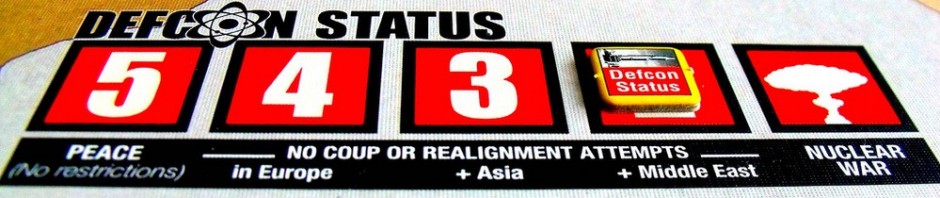
Finally, when DEFCON is high (generally only on Turn 1), the USSR can use Duck and Cover to drop DEFCON by two levels in one play.  Timed correctly, this can effectively shut the US out of an opening coup altogether.

It goes without saying, though, that Duck and Cover is a serious liability for the USSR if DEFCON is already at 2.  It is unplayable and one of the DEFCON suicide cards.  Luckily, it is easy to play on the Space Race.

As US

Generally played for operations, though later on the DEFCON drop and 3VPs makes for a strong headline by denying the USSR its coup and earning a sizable chunk of VPs to boot.  It is slightly risky to headline in the Mid War, because the USSR can headline We Will Bury You (or, more rarely, Soviets Shoot Down KAL-007 in the Late War), dropping DEFCON to 2 and thus causing you to lose by thermonuclear war.

Posted in Early War, US Events | Tagged | 17 Comments