The China Card

The China CardThe China Card

The People’s Republic of China played a pivotal role during the Cold War. While the PRC’s influence was largely limited to satellites in Asia, the country was important to the uneasy balance of power that ultimately descended upon the post-WWII world. While beginning as an ally of the USSR, China became a counter-balance to Soviet influence in Asia during the later stages of the Cold War.

Time: Early War
Side: Neutral
Ops: 4
Removed after event: No

There are four main uses for the China Card:

1. 5 Ops in Asia

This is often the best use of the card in the Early War, when Asia is wide open and ripe for the taking.  Even if the key countries have already been taken, the 5 Ops of the card (possibly 6 if combined with Vietnam Revolts) can flip a 2-stability battleground that isn’t overcontrolled (i.e., if Thailand is 0/2, 5 Ops can make it 4/2).  At the very least, you can even turn India or the Koreas from 0/3 to 4/3.

As noted below, I try not to use the China Card on Turn 1 (as USSR) unless absolutely necessary.  On Turn 2, however, I often try to find a place for the 5 Ops in Asia if it has not yet been scored (and especially if it will be scored this turn).

Later in the game, this becomes less important, especially in the Mid War if Asia Scoring has already come and gone and there are more important regions on the board.

2. Protecting your hand

Playing the China Card allows you to hold one additional card that turn.  This is important for two reasons: sometimes you want to hold a second card and deal with it later, and sometimes you are forced to lose a card and therefore would not be able to hold a DEFCON suicide card to next turn.

The former most commonly refers to the US wishing to hold both De-Stalinization and Decolonization to Turn 3.  This is a very important reason why the USSR should not play the China Card on Turn 1 unless it can already account for one of those two cards!  (Turn 2 is OK because the US won’t get a chance to use it until Turn 3, at which point the question is moot.)

The latter usually means that the USSR wants to hold onto the China Card to protect their hand against Grain Sales to Soviets, Five Year Plan, etc.  This is the main reason to hold onto the China Card instead of playing it — whoever has it has hand flexibility and can plan his hand more effectively and reliably.  (In this sense it is like a Year of Plenty in The Settlers of Catan.)

3. A generic 4 Ops

Fairly common in the Mid War, if neither party is concerned about DEFCON suicide and Asia Scoring has come and gone.  (Or if it is being deployed to protect against DEFCON suicide, as above.)  If a critical region is being scored this turn, then it’s better to spend an extra 4 Ops this turn even if it means giving your opponent a 4 Ops card next turn.  Of course, you would prefer to use another 4 Ops card, but if the China Card is all you have, you shouldn’t hesitate to use it to sway a key scoring card.

This also occasionally happens on Turn 1 if the USSR is dealt a truly miserable hand and has nothing else with which to coup Iran.

4. As 1 VP at the end of the game

In reality, holding the China Card is actually worth 2 VPs, since if you don’t have it your opponent does.  By Turn 10 I am usually looking to hold the China Card at all costs, unless I have a very strong AR7 play worth more than 2 VPs that can only be done with the China Card.

How often the China Card is used tends to depend on how volatile the board is.  In a wide-open board, people will use it nearly every turn, pouring in every Op they can.  In a more conservative, less volatile game, your Ops from the China Card are not as effective, and therefore people tend to hang onto it for insurance.

China Card Events

Formosan Resolution affects the China Card in the Early War, but it’s rarely meaningful because controlling Taiwan is a big investment.  As USSR, though, I will try to play FR after I play the China Card (frequently on Turn 2).

The three Mid War China Card events each have a different effect depending on whether you or your opponent holds the China Card:

China Card belongs to
Event USSR US
Cultural Revolution 1 VP Give to USSR face-up
Nixon Plays the China Card Give to US face-down 2 VP
Ussuri River Skirmish Give to US face-up 4 influence in Asia, no more than 2 per country

In general I am never OK with just handing over the China Card due to any of these events, and often OK with using the event to take the China Card if possible.  Of course, what I am OK with sometimes clashes with what I am forced to do, but all three of these cards are spaceable if necessary.

Cultural Revolution has the worst “friendly China” effect, so bad in fact, that I try to trigger it as US and avoid it as USSR.  As US there is no reason not to just play the China Card first, and then play Cultural Revolution.

Nixon is a decent “friendly China” effect, since 2 VP is the value of the China Card at the end of the game.  Of course, it is probably worth more than 2 VP since you have the option of using the China Card, so as US I prefer to use it to claw back the China Card after using it, rather than just 2 VP.  As USSR I would rather not trigger either of these effects, but if forced to would rather give the 2 VP than the China Card.

Ussuri clearly has the best of both worlds.  As USSR, I almost always space it, and as US, I try to play it while holding a face-up China Card — add 2 influence in each of 2 different countries, the USSR defends one, and the China Card takes over the other.
Posted in Neutral Events | Tagged | 20 Comments

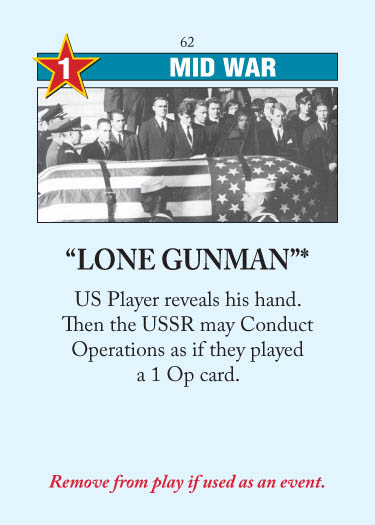
Lone Gunman

Lone GunmanLone Gunman

1963

While campaigning in Dallas, Texas, President John F. Kennedy was assassinated by Lee Harvey Oswald. Two commissions, the Warren Commission, and the House Select Committee on Assassinations, differed over whether or not Oswald acted alone. In any case, the circumstances of the President’s death threw the country into a panic and created ample opportunity for conspiracy theories ranging from the Mafia, the Cuban government, the KGB and America’s own CIA. It also marked the beginning of a string of high profile political assassinations in the United States that would include Dr. Martin Luther King and John Kennedy’s brother (and Democratic Presidential candidate) Robert Kennedy. These untimely deaths shook American confidence and added to the malaise of the Vietnam era.

Time: Mid War
Side: USSR
Ops: 1
Removed after event: Yes

As USSR

I usually try to keep this in the deck, especially if I’m not doing well as the USSR.  But it does make for a decent headline, especially if you draw this on Turn 7 or later and there’s no way it would end up in the US hand anyway.

It’s always lovely when the US is forced to headline this event, especially since you can either use the 1 Op for influence or realignments, and then coup with a bigger card on AR1, or just coup with it in the headline to avoid NORAD.

As US

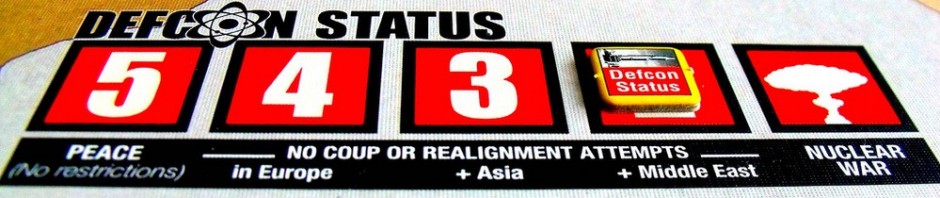
Lone Gunman is in general the most painful DEFCON degrader in the game.  You can’t space it, like with We Will Bury You.  You can’t match it up with Containment, which should usually get triggered in the Early War.  It’s worse than its counterpart CIA Created because you’ll always have influence to target with it, and you can’t play it on AR1.

So unless you headline it, you’ll almost never get a chance to get rid of this DEFCON suicide card.  The general DEFCON article discusses in greater detail how to deal with cards like these, so I will just make a few particular notes:

One unusual way to escape Lone Gunman, if you can’t hold a card to next turn, is to Quagmire yourself on the second-to-last turn holding just Lone Gunman.  As you can’t discard Lone Gunman, you just skip your Action Round and get to hold it to next turn.  Obviously not ideal, but still preferable to DEFCON suicide.

I generally hold Lone Gunman turn to turn until I find some way to get rid of it.  The alternative is just to bite the bullet and headline it, but the problem, of course, is that Lone Gunman causes maximum hurt in the headline phase and can still lose you the game if the USSR headlines a DEFCON degrader.  (Usually the USSR doesn’t, though, since they intend to coup, but NORAD changes this dynamic somewhat.)

However, if you are forced to lose a card, via Blockade, Aldrich Ames Remix, or Terrorism, holding Lone Gunman basically loses you the game if you can’t raise DEFCON or play the China Card.  So if you are threatened by any of those and lack the China Card, you are basically forced to headline Lone Gunman rather than risk the loss.

Finally, never give up just because you realize you are stuck with Lone Gunman!  There is always the chance that the last USSR play will be Ask Not …

Posted in Mid War, USSR Events | Tagged | 12 Comments

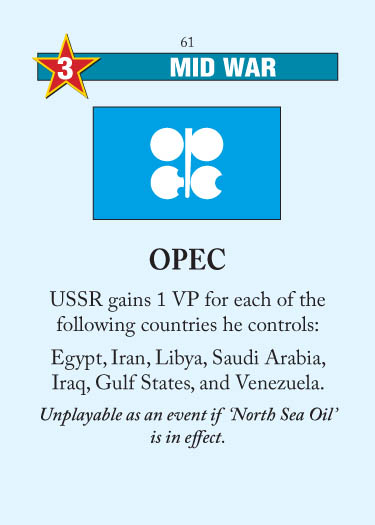
OPEC

OPECOPEC

1960

Founded to allow oil producing countries to have more control over the price of oil, and thereby state revenues, OPEC has grown into an institution that controls two-thirds of the world’s oil reserves and generates roughly half of the world’s oil exports. The creation of OPEC was a major blow to the control of the global oil market by the Western giants like Exxon and British Petroleum. While OPEC does include non-Middle Eastern countries such as Venezuela, Indonesia and Nigeria, it is heavily dominated by countries from that region. As a result, OPEC has intervened in the political crises there. Most famously, OPEC refused oil exports to Western countries supporting Israel in the Yom Kippur (or October) War. This resulted in a 400% increase in oil prices and required rationing in the West.

Time: Mid War
Side: USSR
Ops: 3
Removed after event: No

As USSR

OPEC is a bit like an extra Middle East scoring card, except only for you.  It is up to you how many countries you need in order to trigger OPEC: I have done it for 1 VP, but usually I probably wouldn’t usually trigger it once it is 2 or fewer VPs.  Normally this ends up being around 4-5 VPs; I often hold onto it to see if I can extract some extra value out of it.

As US

OPEC really is like an extra Middle East scoring card, but unlike a Middle East scoring card, it has 3 Ops and therefore can be spaced.  And indeed, I usually do space it, since it is a rare game indeed where this isn’t scoring 3+ VPs.

Alternatively, you can also use the 3 Ops to try to break control of a USSR country to lower OPEC’s effect.  This is like a Special Relationship null play, but carries the disadvantage that you’re probably still giving up some VPs.

On Turn 6, this is one of those cards that I make sure to try to hold past the Turn 7 reshuffle before discarding, since this is particularly bad time to be handing the USSR an extra 4-5 VPs.

Incidentally, any time you see the USSR play into Gulf States, you should be on alert that OPEC is coming.

Posted in Mid War, USSR Events | Tagged | 1 Comment

U-2 Incident

U2 IncidentU-2 Incident

1960

Starting in 1955, the United States began running surveillance flights over the Soviet Union at altitudes beyond Soviet anti-aircraft ranges. However, in May of 1960, a Soviet Sam II missile struck Francis Gary Powers’ aircraft in Soviet airspace. Plane, pilot and gear were captured by the USSR. The incident proved a major embarrassment to the Eisenhower administration, as they initially denied that the US was running such missions. The successful downing of the U-2 caused a major chill in superpower relations and was a propaganda coup for the Soviet Union.

Time: Mid War
Side: USSR
Ops: 3
Removed after event: Yes

As USSR

3 Ops is better than 1 VP, and still better than a chance at 2 VPs.  So unless you’re at -18 or -19VPs, play this for the Ops.

As US

Play this for the Ops and don’t think twice about it, unless you’re at -19VPs, in which case space it, duh.

Pedantical aside

Much more interesting (to me, at least) is whether this card should be “U2 Incident” or “U-2 Incident”.  According to both the 1962 United States Tri-Service military aircraft designation system as well as the U.S. Navy Style Guide, military aircraft is always designated with a hyphen (e.g., U-2, F/A-18 Hornet, B-52 Stratofortress).  But in Twilight Struggle, both the card and the Player Aid Card List omit the hyphen. (Oddly enough, the historical notes at the end of the rulebook, as reprinted above, do include the hyphen.)

Of course, it is possible that the event is actually referring to an incident involving a certain Irish rock band, and the picture of the plane is just thrown in there to confuse us.

Posted in Mid War, USSR Events | Tagged | 7 Comments

Flower Power

Flower PowerFlower Power

1965 – 1970

A term reportedly coined by the poet Allen Ginsberg, “flower power” came to represent the nonviolence and peace movements of the 1960s. The classical context for the phrase was the placement of daisies into rifle muzzles, and the anti-war slogan “make love, not war.” Flower power is also representative of the general ambivalence to the use of military force that resulted from the American experience in Vietnam.

Time: Mid War
Side: USSR
Ops: 4
Removed after event: Yes

As USSR

It is hard for me to imagine when I would ever play this for the event.  Conceivably, if I used Lone Gunman to spy on the US hand, and saw that they had literally a ton of “War” cards, then Flower Power would be worth it.  Conceivably.

Otherwise, the benefit is just way too speculative to pass up 4 Ops.  As a 1 Op card, I might take the chance.  As a 4 Ops, you’d have to be crazy, desperate, or most likely, both.  Like NATO, this is one of those events you have to hope the opponent triggers for you.

As US

Like the USSR, you are probably not going to pass up the 4 Ops from this card.  Unlike the USSR, you’re going to have deal with its ill effects later on: chances are, you’ll probably draw at least one or two “War” cards and be forced to space them or lose 2 VP per.  Fairly annoying, and everyone has forgotten about Flower Power at one point or another and lost 2 VP without realizing it.

Generally I’ll just space the War cards, which isn’t a big deal until you have other cards you want to space as well (or if you’re Purged).  Brush War is of course the main exception.

Usually I don’t end up playing An Evil Empire for the event unless I also have a lot of “War” cards in hand with An Evil Empire.  And it goes without saying that if you draw Flower Power with “War” cards in hand, you should play all the Wars first.

Note that Arab-Israeli War, if prevented by Camp David Accords, does not count for Flower Power and is a safe play.

Posted in Mid War, USSR Events | Tagged | 22 Comments

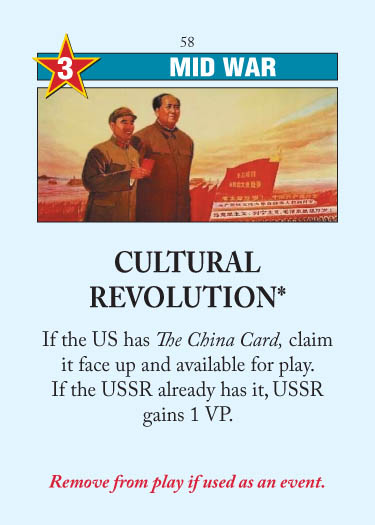
Cultural Revolution

Cultural RevolutionCultural Revolution

1966 – 1977

While primarily representative of an internal power struggle within the People’s Republic of China, the Cultural Revolution had profound international implications. As Mao Zedong felt increasingly marginalized by moderates within the Chinese Communist party, he lashed out to restore ideological purity and train the next generation of revolutionaries. The resulting turmoil of purges, denunciations, and creation of the Red Guard brought China to the brink of civil war. It also made more pronounced, the rupture between China and the Soviet Union. However, the anarchy and isolationism that reigned made rapprochement between the United States and the PRC impossible. As the Nixon administration took office, the gulf between the two nations appeared wider than ever.

Time: Mid War
Side: USSR
Ops: 3
Removed after event: Yes

As USSR

Of the three China Card events (Nixon Plays the China Card and Ussuri River Skirmish are the others), this one has the least useful “if you already have the China Card” effect.  1 VP for 3 Ops is pathetic and almost never worth the trade.

However, claiming the China Card face-up is much more lucrative: having the China Card helps protect you from DEFCON suicide and makes it much easier to manage your hand.  I will therefore often play this to claim the China Card if I can spare 3 Ops.  If I already hold the China Card, I usually just use Cultural Revolution for the Ops, but occasionally I’ll play the China Card first, and then take it back with Cultural Revolution.

If for some reason you know that the US is holding Cultural Revolution (say, on Turn 7), it’s nice to play the China Card, giving it to them face-down, and forcing them into a difficult decision (hold Cultural Revolution to next turn, space it, or play it and give back the China Card face-up).

As US

By definition, the China Card is worth at least 2 VPs because whoever holds it at the end of the game gets 1 VP.  So there’s no reason to play this and just hand over the China Card, especially face-up.  If you draw this holding the China Card, you should always play the China Card first, then trigger it for a measly -1 VP.  And if you draw it while the USSR holds the China Card, try to play it as soon as possible, because the only time this card is really annoying is when you have the China Card face-down.

Posted in Mid War, USSR Events | Tagged | 4 Comments

ABM Treaty

ABM TreatyABM Treaty

1972

The Anti Ballistic Missile Treaty sought to cement the system of mutually assured destruction as the lynchpin of strategic balance. The ABM treaty restricted the ability of the two superpowers to defend themselves from nuclear strike. In theory, this made a first strike to prevent the introduction of destabilizing defensive systems unnecessary. Both nations were allowed to defend either their capital or one field of ICBMs with a missile defense system. The Soviets deployed such a system around Moscow. Ultimately, the US abandoned its system deployed in Grand Forks, North Dakota.

Time: Mid War
Side: Neutral
Ops: 4
Removed after event: No

One of the Big Three Mid War neutral events, along with Brush War and Junta, and easily one of the best events in the game.

Its most common use is as a free 4 Ops coup after DEFCON drops to 2.  (Somewhat ironic that an anti-ballistic missile treaty is intended to launch coups, but that’s Cold War logic for you I suppose.)  This is a pretty self-explanatory way to dramatically alter the dynamics of South America or Central America, and more rarely a way to really, really lock up an African battleground.  For the US, they get a small bonus here with NORAD.

You can also headline this to conduct operations in the headline.  Headlining it (or playing it on AR1, as USSR) gives you the chance to perform the rare Asia coup, possibly flipping Thailand or Pakistan.

Of course, being able to conduct operations in the headline is an all-around useful tactic.  The US can perform the SALT-ABM trick: use SALT Negotiations to reclaim ABM Treaty to your hand at the end of the turn, pushing DEFCON up two levels.  Then as DEFCON rises to 5 next turn, you headline ABM Treaty and get to conduct operations in Europe in the headline phase: typically a series of realignments, though occasionally you might see an Italy coup.  The USSR can do this too, but it’s a little bit trickier: first, you’re giving the US a free (albeit -1) battleground coup on AR7; second, the US might headline Defectors; third, a US 4 Ops headline would trigger before yours.  The US faces none of these problems.

Posted in Mid War, Neutral Events | Tagged | 8 Comments

Introducing the Twilight Strategy Forum!

The much-requested forum is now live!  There’s a fantastic community around this site, and we’re excited to provide an outlet for conversation (and Missile Envy rules questions).

As always, we welcome feedback; either email us directly, or post it in the Twilight Strategy Feedback forum.

Posted in Uncategorized | Leave a comment

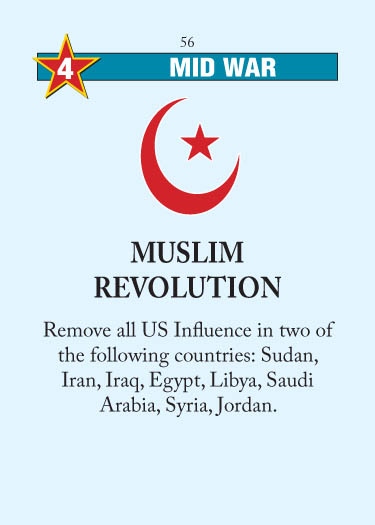
Muslim Revolution

Muslim RevolutionMuslim Revolution

1979

As secular Arab and Muslim states throughout the Middle East displayed corruption, repression and incompetence, more radical forms of Islam began to come to the fore. The Muslim Brotherhood, founded in Egypt, sought to topple the secular regime there and in Syria. This led to further cycles of repression and authoritarian rule within these countries. A similar cycle took place in Iran under Mohammad Reza Shah Pahlavi. A long standing regional ally of the United States, and the West generally, the Shah was deposed by a popular revolution led by the anti-western Ayatollah Khomeini. This ushered in the world’s first contemporary theocracy. Iran’s Mullahs would spend the rest of the 20th Century in efforts to export their revolution to other Shia Muslim communities.

Time: Mid War
Side: USSR
Ops: 4
Removed after event: No

As USSR

Muslim Revolution is one of the main reasons US players tend to avoid the Middle East.  This is therefore one of those cards that derives much of its power from the threat rather than its actual effect.  And since it is a 4 Ops card, I am often tempted to use it for Ops instead of the event, particularly if Middle East Scoring has come and gone.

In general, there are three reasons I will play this for the event:

First, when the US controls the 3-stability battlegrounds (Iraq and Saudi Arabia).  They lose more influence, and also can’t recontrol both in a single turn.

Second, you have enough influence in the country to automatically take it over.  For example, if Iran is already at 4/2, then it goes to 0/2 and becomes yours after Muslim Revolution, instead of going from 2/0 to 0/0.

Third, if the US has no access to the affected battlegrounds and therefore can’t get back in before you.  If the US has no influence in Tunisia, Sudan, and Israel, then they can’t do anything about losing Libya/Egypt, and you have a lot of time to control them.  This is especially pertinent if it is knocking the US out of the region entirely — but be mindful of Sadat Expels Soviets / Camp David Accords!

Of course, make sure that what you’re doing actually affects the scoring of the region.  If the region is tied 3-3, or you are being dominated 4-2, then you’re OK with knocking the US out of two battlegrounds, letting them take one back, and then taking the other.  But if you are losing the Middle East 5-1, you need to be able to take both battlegrounds before the US does to make it worthwhile.  And if you are dominating the Middle East, then re-evaluate whether you really need the benefit from Muslim Revolution. (Of course, Shuttle Diplomacy throws a wrench into all of this math.)

As US

A notorious bugbear for American players, and a commonly-spaced event.  But the threat that Muslim Revolution poses is often overrated: provided the three conditions listed above do not apply, it is usually a null event like Socialist Governments.  If you are 2/0 on Libya/Egypt, then you lose 4 influence and have 4 Ops to put them back in.  Influence in Israel and Tunisia is a great way to do this.

Note that Muslim Revolution—crucially—does not affect Israel or Lebanon, two great places for the US to hide during the Muslim Revolution.  This is partially why Lebanon is such an important country to take in the Early War, since it is the only Middle East country completely immune to bad events until the Late War.

Posted in Mid War, USSR Events | Tagged | 7 Comments

Willy Brandt

Willy BrandtWilly Brandt

1969

An ardent socialist and opponent of the Nazi party during his youth, Willy Brandt led the West German Socialist Democratic party to the Chancellorship in 1969. There he implemented the same pragmatic approach to east-west linkages that had characterized his mayorship of West Berlin. Termed Ostpolitik, under Brandt, West Germany normalized relations with the Soviet Union, Poland and Czechoslovakia. While not abandoning the notion of German reunification, he acknowledged the inviolability of existing borders and went on to normalize relations with East Germany. Ultimately, his government was brought down by an internal spy scandal.

Time: Mid War
Side: USSR
Ops: 2
Removed after event: Yes

As USSR

The only reason you’d ever want to play this for the event is for VP; adding 1 influence into a 4-stability country is like drilling for oil with a toothpick, and you’d rarely want to realign, much less coup, West Germany anyway.

If France somehow is still empty on Turn 4, Willy Brandt makes a decent headline by “kicking down the door” to France and giving you access.  But you should have already gotten access to France, either by forcing your way into West Germany/Italy earlier, or Decolonizing into Algeria.

As US

If you really, honestly, have nothing else to space, then you may as well space Willy Brandt.  Usually I’m more than happy to give the USSR a VP and play the 2 Ops, especially since I probably used Marshall Plan to shore up West Germany a little.  If it hasn’t been triggered, then Willy Brandt is equivalent to a 1 Op if you use the other Op to repair West Germany.  But you don’t even really need to repair West Germany yet if Europe Scoring has come and gone.

Posted in Mid War, USSR Events | Tagged | 7 Comments