Early War recap

The analyses for all of the Early War cards are finished.  Here is a brief summary of the Early War cards (including Optional Cards, as always):

Early War Neutral US USSR All cards
Scoring 3 3
1 Ops 2 2 3 7
2 Ops 2 4 6 12
3 Ops 5 6 11
4 Ops 2 3 5
Total cards 9 | 6
14 15 38 | 35
Total Ops 14 37 33 84
Average 1.56 | 2.33 2.64 2.20 2.21 | 2.4

The average Early War hand should have 17.7 Ops.  Subtract headline and hold card, and you normally expect to play about 13-14 Ops per turn.

Notice that although there are more US Ops than USSR Ops, this usually is a bad thing for the US; for example, they have no 4 Ops USSR starred events to eliminate from the deck or discard to Red Scare/Purge + Blockade, and on average USSR events have fewer Ops to deal with their own effects.

Posted in Cards, Early War | Leave a comment

NORAD

NORADNORAD

1958 – ?

The North American Aerospace Defense Command is a joint military organization sponsored by the governments of Canada and the United States. Its mission is to jointly monitor and control the air space over North America from unfriendly incursion. It was founded initially to protect against the threat of low flying Soviet bombers attacking from the Arctic region. During the Cold War, the Command was famously housed in the Cheyenne Mountain facility depicted in the film Wargames. At its height, NORAD commanded 250,000 military personnel. The command illustrates the full integration and cooperation of US allies into the US nuclear umbrella and alliance structure.

Time: Early War
Side: US
Ops: 3
Removed after event: Yes

As USSR

This is a controversial event.  Some think it’s useless and too expensive to activate; others consider it the among the best US events in the game.

Certainly, however, everyone is in agreement that it’s not a great card for the USSR to draw, because it’s a bit too good for the USSR to play it for the US.  Accordingly, I like to space this card as USSR, but find that I often can’t spare the Ops.  In particular, on Turns 1 and 2, I’ll usually just play it for Ops because the event is not particularly useful until the Mid War.  But if I am able to, I will send this to space rather than deal with the consequences for the rest of the game.

NORAD has an unusual counter in Socialist Governments, which is an all-around good USSR headline, but especially useful to defuse NORAD for an Action Round.

When NORAD goes into play, it becomes more important to overprotect your controlled battlegrounds, especially your 2-stability battlegrounds, if the US has influence in them.

NORAD is most annoying when you drop DEFCON to 2, because the US gets an influence and then gets to play immediately afterwards.  If the US drops DEFCON to 2, then it’s not as much of a problem to deal with.  This suggests that in AR7 play situations, NORAD’s presence sometimes means that you should be willing to give up the battleground coup.

Finally, I usually save Quagmire and hope to draw Red Scare/Purge with it as the USSR, but with NORAD active I will trigger Quagmire ASAP.  Conversely, if NORAD is not out, I’ll hold Quagmire until NORAD comes out (or until I draw Red Scare/Purge).

As US

NORAD makes it important to control Canada.  The best way to do so is to let the USSR do it for you: Marshall Plan and Special Relationship can often provide the boost you need in Canada without having to invest any of your own influence.

The real problem with triggering NORAD is giving up its 3 Ops.  On Turns 1 and 2 in particular, I tend to play NORAD for the Ops and hope it comes back to me early enough in the Mid War.  By Turn 3, I will generally try to spare the Ops rather than punt it until Turn 7 at the earliest.

The best way to make use of this is to have influence in USSR-controlled battlegrounds.  2-stability battlegrounds in otherwise DEFCON-restricted areas are great targets; the African battlegrounds are as well, but those are generally less stable and swing back and forth much more than say, Libya.  In addition, the USSR’s Asian battlegrounds, even the 3-stability ones, are excellent places for NORAD because the 5 Ops of the China Card allow you to flip more stable countries.

NORAD somewhat clashes with the typical US goal of lowering DEFCON to 2 in the headline phase.  In other words, by preventing the AR1 coup, you miss out on NORAD’s compensation for that coup.  It does, however, work nicely with ABM Treaty and SALT Negotiations, both of which can cause DEFCON to go to 2 multiple times in a turn.

An active NORAD makes Quagmire even more unplayable, not that you wanted to play it on yourself before anyway.

Posted in Early War, US Events | Tagged | 34 Comments

Special Relationship

Special RelationshipSpecial Relationship

1946 – ?

The Special Relationship is a phrase used to describe the exceptionally close political, diplomatic, cultural, economic, military, and historical relations between the United Kingdom and the United States, following its use in a 1946 speech by British statesman Winston Churchill.  During the Second World War, the development of the atomic bomb required collaboration and trust between the British, Canadian, and American governments to a degree perhaps previously unimaginable. Additionally, in 1943, Britain made the crucial decision to share ULTRA codebreaking results directly with US intelligence. This relationship blossomed into the BRUSA Agreement, whose terms guided intelligence sharing throughout the Cold War. Even today, the UK and US remain the closest of allies, sharing military bases and economic ties throughout the world.

Time: Early War
Side: US
Ops: 2
Removed after event: No

As USSR

Depending on whether Special Relationship is NATO-activated, this can be either a minor annoyance or an irritating source of US VPs.

The best case scenario is when the US doesn’t control the UK.  This will happen somewhat naturally from Suez Crisis; the US usually has too many priorities for its influence than to repair the UK early on, and so you can often get away with a no-effect Special Relationship.

If the US does control the UK, but NATO is not in effect, then look to its neighbors.  If the US already controls both France and Canada, then you can consider the influence to be moot and safely disregard the event text.  If they don’t control Canada, then try to delay playing Special Relationship until they do.  In the worst case scenario, where you control France, you’ll have to spend at least one Op of Special Relationship to repair its damage.

Once Special Relationship is NATO-activated, it becomes much more powerful.  A competent US player will never trigger NATO, but you almost certainly will, because its 4 Ops are too much to pass up.  So if you hold both in the same hand, you should play Special Relationship first.  (As discussed in the NATO article, this is also good reason to try to delay Warsaw Pact Formed and Marshall Plan, so you can punt NATO for no effect.)

If you do hold Special Relationship in a post-NATO world, you can either use the two Ops of Special Relationship to try to break UK control before triggering the event text, send the card to space (though there are many good US candidates for the Space Race around this time in the Mid War), or just bite the bullet and accept that it’ll cost 2VP to use 2 Ops (assuming, of course, that you are fine with giving the US two influence in a western European country).

As US

If Special Relationship is not NATO-activated, then there is obviously no point to playing it for the event, since you can (almost) always use its 2 Ops to duplicate its effect (the exception being if you are under Red Scare/Purge and want to use Special Relationship to break USSR control of France).

If Special Relationship is NATO-activated, then it becomes a somewhat tempting event: the 2VP is quite nice by itself, and the two US influence is helpful if the USSR controls Italy or France.

You should never, however, play NATO to boost Special Relationship.  NATO is one of the crappiest events in the US arsenal, and it should only ever be triggered by the USSR.

The real benefit of Special Relationship is that the USSR is often forced to play it for you.  This is a good reason, therefore, to control the UK: Suez Crisis will wipe out one or two influence, and occasionally Socialist Governments might take one out of it as well.  I wouldn’t go out of my way to control the UK, especially if NATO hasn’t been activated, but you should make sure that at least one influence from Marshall Plan makes its way to the UK.  Once NATO has been activated, if Special Relationship is still in the deck, then I would definitely drop a spare influence into the UK when you have a chance.

Along the same lines, in the Early War, if you do control the UK but NATO has not been activated, it’s to your benefit not to immediately control Canada, so that you have a useful place to drop the influence from Special Relationship.  Of course, sometimes you will have to control Canada before he plays Special Relationship, in which case you’ll have to settle for overcontrolling France.
Posted in Early War, US Events | Tagged | 10 Comments

The Cambridge Five

The Cambridge FiveThe Cambridge Five

1934 – 1963

The Cambridge Five (Kim Philby, Guy Burgess, Anthony Blunt, John Cairncross, and Donald Maclean) were British civil servants who, unbeknownst to the British government, had become Communists while at university, and recruited as Soviet agents shortly thereafter. The spy ring was one of the most effective Soviet intelligence efforts of the Cold War, as all five rose to positions of great responsibility and trust in the civil service. Maclean, in particular, was privy to a large number of nuclear secrets; the information regarding the size and readiness of the Western nuclear arsenal played a key role in Stalin’s decisions to blockade Berlin and to arm the North Koreans for their invasion of South Korea. The spy ring fell apart when the U.S. VENONA project exposed Maclean; he and Burgess defected in 1951. Philby was able to elude exposure until 1963, passing secrets all the while; he too managed to defect. Blunt was unmasked around the same time, but secretly gave a confession, exposing other agents (including Cairncross).

Time: Early War
Side: USSR
Ops: 2
Removed after event: No

As USSR

This is an event that is generally triggered only in the headline phase.  It is a somewhat weak headline for the USSR only because the odds of success are usually low.  Nevertheless, the payoff can be huge: not only can you combo it with an AR1 play to take over a battleground (a sort of USSR NORAD), you can also use it to gain access in a critical region that you are otherwise locked out of (like a mini De-Stalinization).

The Cambridge Five is best headlined on a turn that maximizes the odds of the US having a scoring card in hand: on Turn 3 or Turn 7, you may be able to positively identify a particular scoring card in the US hand if it hasn’t shown up yet in that reshuffle.  Alternatively, it’s also a wise headline if it’s Turn 6 and few of the scoring cards have yet shown up in the Mid War reshuffle.  It should go without saying that if the reverse is true (if all the scoring cards have come out already), then this is a null headline.

Note that if the US has multiple scoring cards, the USSR chooses one (and only one) of them to apply to the Cambridge Five.

As US

Completely harmless, so long as you play it with no scoring cards left in your hand.  It is ideally played at the end of your turn, as the knowledge that you have no more scoring cards can be advantageous to the USSR, but even if you have to play it earlier in the turn, it’s not really that bad of an event (because it does not expose the rest of your hand).

Posted in Early War, USSR Events | Tagged | 10 Comments

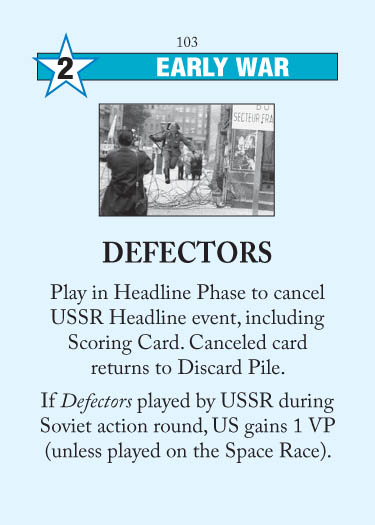
Defectors

DefectorsDefectors

1945 – 1989

Preceding the start of the Cold War, citizens of the Eastern bloc fled or defected to the West. Defectors came in two primary archetypes. Spies and double agents who had been discovered or needed to “come in from the cold” would frequently flee to their masters and allude capture. Examples of this type of defector include KGB Deputy Chief Yuri Nosenko and KGB London Bureau Chief Oleg Gordievsky. Perhaps more embarassingly, and certainly more publicly, many talented Soviet artists defected while on tour in the United States or Europe. While the West also suffered occasional defections, particularly from westerners involved in espionage, it never reached the same proportion or the same level of public spectacle.

Time: Early War
Side: US
Ops: 2
Removed after event: No

As USSR

As USSR, I only consider the threat of Defectors to be a deterrent when I am risking the loss of:

In other words, I usually don’t particularly care about Defectors.  Headlines like Junta, or a Turn 1 Suez Crisis are great, but not the end of the world if they get cancelled.

As USSR, if I draw Defectors on Turn 1 or 2, I will try to hold it until Turn 3 before playing it for Ops.  This keeps it out of the Turn 3 reshuffle and ensures worry-free headlines for most of the game.  This is analogous to the US holding Decolonization/De-Stalinization until Turn 3, though Defectors is not nearly as important as they are.

A common USSR trick against Defectors is to headline a scoring card for a region that you are being Dominated in.  This is most effective when against a relatively inexperienced US player, and when you haven’t seen Defectors come out Turns 1 or 2 (meaning it is guaranteed to be in his hand on Turn 3). It is one of the rare ways to discard a scoring card without scoring the region.  Of course, you can also headline an actively-dangerous US card when you expect the US to be headlining Defectors, but that’s much more risky, whereas the downside risk of headlining the scoring card is much lower.

As US

Most beginning players are too eager to headline Defectors.  Not only is it risky on Turn 3, as described above, but more generally, I prefer to headline more aggressively as the US (e.g., Red Scare/Purge, Grain Sales to Soviets, The Voice of America).  Obviously you don’t always have the luxury of such powerful events, but in general, cancelling the USSR headline doesn’t seize the initiative and keeps you on your heels.

That having been said, Defectors is a fine headline.  By preventing the headline-AR1 combo, you negate one of the USSR’s most powerful weapons against you.  If I draw it with a powerful headline I will headline the other card and hold Defectors until next turn.

A quick rules clarification: Defectors, if headlined, will always cancel the USSR headline regardless of Ops value.  The edge case is: if you headline Five Year Plan and draw Defectors, Defectors will now only cancel the USSR event if the USSR headline triggers “after” the Five Year Plan headline.  In other words, if the USSR headlines a 4Ops card, it wouldn’t be cancelled by the Five Year Plan – Defectors interaction, but any 3 Ops or lower headline will be.

Finally, and this should go without saying, if the USSR has made it to the stage of the Space Race where he can see your headline before he chooses his, do not choose Defectors!  All you’re doing is allowing to discard a US or scoring card of his choice.

Posted in Early War, US Events | Tagged | 11 Comments

Formosan Resolution

Formosan ResolutionFormosan Resolution

1955

Reacting to the “loss of China” the United States Congress extended to President Eisenhower open ended authority to defend Taiwan—technically known as the Republic of China on Taiwan—with military force. The resolution came at a time when the United States faced challenges from the People’s Republic in Indochina as well as the Korean peninsula. Effectively, Taiwan sat under the US nuclear umbrella, and the balance of power within the Taiwan Straits would now remain a question of strategic importance to the United States.

Time: Early War
Side: US
Ops: 2
Removed after event: Yes

As USSR

Generally inconsequential. It is only relevant if the Asia battlegrounds split 3-3, and even then most US players do not bother taking Taiwan early on because of its cost.  I will almost always play it without hesitation in the Early War, especially if the US has the China Card.

Occasionally, in the Mid War, if Taiwan is already taken by the US (i.e., to protect against Korean War) and the battlegrounds are indeed split 3-3, then Formosan Resolution can give the US Domination.  But I find this somewhat rare — much more likely is that the US ends up cancelling it by playing the China Card before Asia is scored.

Note that unlike Shuttle Diplomacy, this does not go away after Asia is scored, only after the US plays the China Card.  It also matters for Final Scoring.

As US

Unless I already have Taiwan for some reason, this is not worth the effort.  It’s just too many Ops in the Early War: Taiwan is a costly country and you’d have to give up the 2 Ops from Formosan Resolution too.

Sometimes this can be helpful in a Mid War deadlock.  But even then, the tedious process of playing Formosan, controlling Taiwan, and then playing Asia Scoring is usually too slow.

That having been said, this is a second reason to take Taiwan, the first being a defense against Korean War.  Usually either of those reasons on their own is not enough to take Taiwan, but together, I will probably invest the 3 Ops.

Posted in Early War, US Events | Tagged | 21 Comments

Annotated Game #2: Mid/Late War

This is Part II of a two-part series. Part I, the Early War, can be found here.
Continue reading

Posted in Annotated Games | 20 Comments

Annotated Game #2: Early War

This is an annotated game I played as USSR against Gabor Foldes, the 2012 Internet Twilight Struggle League champion.  We play with Optional Cards and +1 influence for the US player (to be placed in any country where the US already has influence).

The game is played on Wargameroom. The save game can be downloaded here, if you wish to replay the game on Wargameroom.  As an alternative, there is a complete record of play here as well.

Because this is such a long game, this post has been split into two sections.  Part I, the Early War, is published below.  Part II, the Mid/Late War, can be found here.
Continue reading

Posted in Annotated Games | 26 Comments

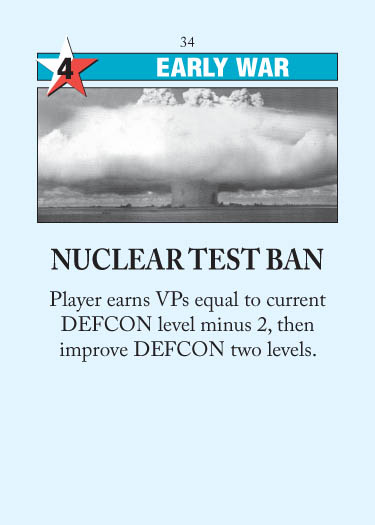
Nuclear Test Ban

Nuclear Test BanNuclear Test Ban

1963 – ?

The first Nuclear Test Ban treaty owes its origins to the de-escalation process that followed the Cuban Missile Crisis. It prohibited further nuclear tests in the air, underwater or in space. International pressure for such a ban mounted in the 1950s as scientific evidence began to document severe environmental damage caused by earlier atmospheric testing by the nuclear powers. Underground testing remained an allowable methodology, but all forms of “peaceful nuclear explosions” were also banned, tightening the non-proliferation regime.

Time: Early War
Side: Neutral
Ops: 4
Removed after event: No

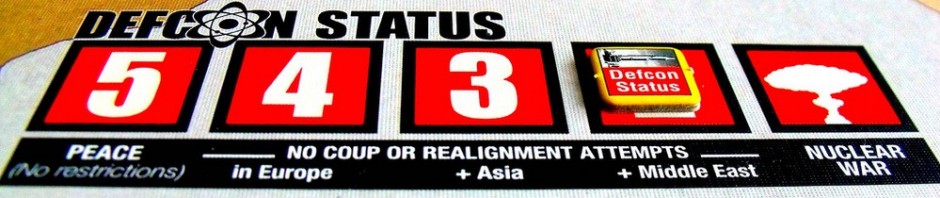
This event is just awful.  Most of the time, it’s a 0VP card that you would trigger for the event only when you have DEFCON suicide cards in your hand.  The fact that it raises DEFCON by two levels (usually, to DEFCON 4) means that you will usually get a Action Round at DEFCON 3 after your opponent coups from DEFCON 4 to 3.

The other corner case is when DEFCON starts off very high for some reason, at which point this is a 4Ops for 3VPs trade.  Still not great, but maybe sometimes those 3VPs can be important.

But both of these are desperation moves.  98% of the time, this is just a powerful 4Ops card whose event text you skip over.  Even in that 2% where the event is meaningful, you probably would have rather been playing How I Learned to Stop Worrying (in the first case) or Arms Race (in the second case).

That’s not to say its presence in the game is bad, or that the card needs a better event text.  It serves a niche role, but a crucial one (when it comes up).  More generally, not every event can, or should, be Red Scare/Purge or Grain Sales to Soviets: sometimes you just need to play Ops.  A game where every event was game-changing would probably be too swingy to enjoy.

Posted in Early War, Neutral Events | Tagged | 15 Comments

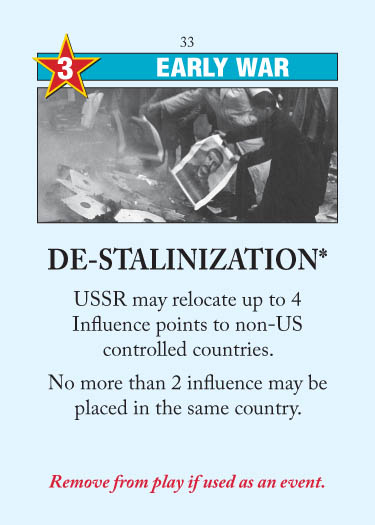
De-Stalinization

De-StalinizationDe-Stalinization

1956

During the 20th Party Congress, Nikita Khrushchev openly attacked Stalin’s leadership of the Soviet Union. It was seen both inside and outside the Soviet Union as the beginning of a new era. This proved to be a particularly bloody assumption for Nagy’s Hungary. Khrushchev had no intention of “liberalizing” Soviet domination of Eastern Europe, even if he was trying to bring an end to the cult of personality that had characterized internal Soviet government.

Time: Early War
Side: USSR
Ops: 3
Removed after event: Yes

As USSR

This is probably the most important Early War card in the deck.  Without De-Stalinization, it will be very difficult to contest the Americas.  As such, no matter how tempting, I almost always try to use all of the influence from De-Stalinization into a Mid War region.  Occasionally I will put one into Thailand, if I need immediate access to it, but the card is best for fighting for the Mid War regions.

I also rarely headline this card, because it is a very risky card to have Defectored.  Moreover, you have to play this at DEFCON 2, so that the US doesn’t just coup out your influence immediately.

If you have Decolonization, then De-Stalinization is an easy choice: all four into the four South American battlegrounds.  If you don’t have Decolonization, I will tend to put a couple into Africa (perhaps Angola and Algeria), and the other two into South America (one in Venezuela and one in Argentina or Chile).  I don’t usually place it into Central America, because I can coup Panama, Fidel grants me Cuba, and Mexico is too easily realigned out.  More importantly, De-Stalinization into South America gives me more access than De-Stalinization into Central America.

Remember that The Voice of America is the perfect antidote to De-Stalinization, so be sure to fortify your position by the Mid War so that VoA cannot just remove all of your influence.

As US

Like Decolonization, this is a hold-until-Turn-3 card.  Whether or not the USSR triggers this can be game-deciding, so spacing it on Turn 3 earns you a massive advantage.  By Turn 7, this card is mostly useless, and can be safely played for Operations.  But I would rather give up West Germany to a Blockade than play this in the Early War.

In many ways, De-Stalinization is like Puppet Governments, with the key difference being that it is guaranteed to be drawn by Turn 3, when it still matters.

Posted in Early War, USSR Events | Tagged | 38 Comments