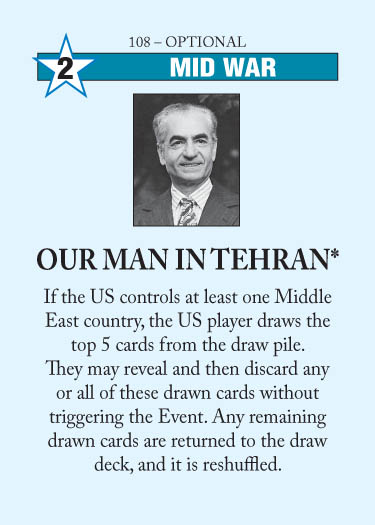
Our Man in Tehran

Our Man in TehranOur Man in Tehran

1941 – 1979

Replacing his deposed father, Mohammad Reza Shah Pahlavi was central to first British and then American plans for the Middle East. While Pahlavi undertook the mantle of western reformer, he often chafed under neo-imperialist economic relationships, particularly where oil was concerned. Nevertheless, Iran’s oil wealth spurred Pahlavi into the center of global geopolitics and his association with the United States  was vital for both nation’s positions in the region. However,  whatever outward elements of reform Iran projected, Pahlavi also used a brutal internal police force, the SAVAK, and turned despotic and megalomaniacal in the later years of his reign. This was all the opening required for Iran’s seething revolutionary elements.

Time: Mid War
Side: US
Ops: 2
Removed after event: Yes

As USSR

Our Man in Tehran hovers just at the border of send-to-space and suck-it-up.  If I can spare the Ops, I like to send it to space, but I rarely can, and so I often just end up playing it and hoping the US doesn’t find anything good.

If you’ve already seen the important cards (good scoring cards or good USSR events like Lone Gunman, We Will Bury You, Decolonization, Muslim Revolution, OPEC, etc.) go to the discard, then it’s not a big deal.  It’s also not a big deal in the rare situation where the US controls no Middle East country, or only controls a single one (and you can use the Ops to break control of the country).  And although it is slightly less effective on Turn 6 then at other times, that alone is not enough reason to feel safe about playing it.

As US

A very nice event and one I almost always trigger.  It is worst on Turn 6, but even then it is better than its 2 Ops, especially if you have not yet seen an important card you wish to discard.

Posted in Mid War, US Events | Tagged | 12 Comments

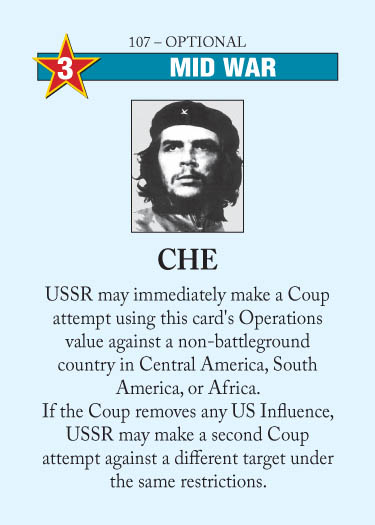
Che

CheChe

1955 – 1967

Ernesto “Che” Guevara, commonly known as el Che or simply Che, was an Argentine Marxist revolutionary, physician, author, guerrilla leader, diplomat, and military theorist. A major figure of the Cuban Revolution, his stylized visage has become a ubiquitous countercultural symbol of rebellion and global insignia within popular culture.  Guevara remains both a revered and reviled historical figure, polarized in the collective imagination in a multitude of biographies, memoirs, essays, documentaries, songs, and films. As a result of his perceived martyrdom, poetic invocations for class struggle, and desire to create the consciousness of a “new man” driven by moral rather than material incentives, he has evolved into a quintessential icon of various leftist-inspired movements.

Time: Mid War
Side: USSR
Ops: 3
Removed after event: No

As USSR

One of the best (and most underrated) USSR events.  Launching two simultaneous coups allows you to set up countries for realignments, defend against US AR7 moves, or threaten multiple countries at once.  Consecutive Action Rounds are one of the holy grails of Twilight Struggle, and Che comes close.

The best use of Che comes when you can make two threats and the US can only respond to one.  Most non-battleground countries are valuable for their connection to a battleground, and sometimes the only response to an attack on a non-battleground is to coup it back.  When you identify two such non-battlegrounds, take advantage of the opportunity to double coup.  Now the US must choose one non-battleground to respond in, and you are free to leverage the other non-battleground against an adjacent battleground (either by direct influence placement or realignment).

Che gets better as the game goes on and more influence is invested into non-battlegrounds.  Most games tend to have a pattern of low investment into non-battlegrounds (out of fear of being couped out), followed by rapid investment into non-battlegrounds (where there is no longer enough “time” / Action Rounds to coup them all back efficiently).  It is in that later stage that Che becomes so powerful.

The fact that Che earns you Mil Ops (unlike Junta) is just icing on the cake.

As US

If you don’t have any targets (or only one target), it’s a relatively safe play, particularly since you can coup back whatever Che coups.  It’s also safe if your non-battlegrounds are 3-stability (i.e., Costa Rica).  But once you get into the stage of owning many non-battlegrounds, as described above, Che is too dangerous to play (it is equivalent to 6 Ops for the USSR!) and better off sent to space.

Posted in Mid War, USSR Events | Tagged | 13 Comments

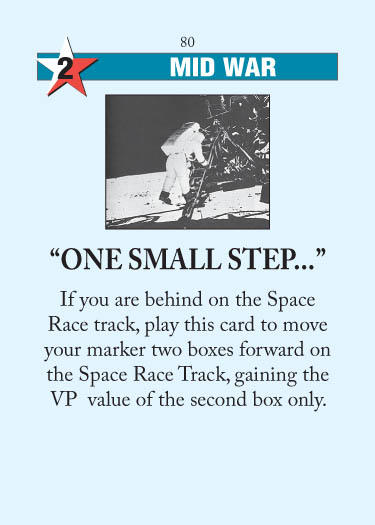
“One Small Step…”

One Small Step...“One Small Step…”

1961 – 1969

After years of lagging behind Soviet space exploits, the United States put its full intellectual and economic weight behind the “race to the moon”. President Kennedy initiated Project Mercury. Ultimately, the National Aeronautics and Space Administration would overcome enormous technological hurdles to place a man on the moon. As Neil Armstrong, the first human to set foot upon the moon’s surface, descended from the space craft, he uttered the immortal line “one small step for a man, one giant leap for mankind.” In so doing, he confirmed an American come-back victory in the space race between the superpowers.

Time: Mid War
Side: Neutral
Ops: 2
Removed after event: No

There are a couple of uses for this card.  The most common is to leapfrog onto the 2/0 VP space to claim the 2VPs for yourself; then this event is like a 4VP swing (maybe adjusted for space race luck?) and worth it.  You can also stop an opponent from peeking at your headline, and occasionally be able to jump ahead to the 3/1 VP space (even more useful than the 2/0 space).  In general it is more effective the later it is played, like Captured Nazi Scientist.

It is best played when you are exactly one space behind your opponent, so that you can reap the benefit of the slot you are jumping to.  Occasionally it is worth it to jump to the peek-at-headline space when you are two boxes behind your opponent, but ideally you’d space something first, and then use One Small Step to get the 3/1 VP bonus too.

One Small Step is often also a hidden source of VPs.  Among experienced players that try to keep track of what cards can still award VPs in the Late War, One Small Step is commonly forgotten.

The great danger One Small Step poses (like Captured Nazi Scientist) is that you could leap too far forward and no longer be able to space 2Ops cards.  This is especially a problem for the USSR, who would love to peek at your headline, but perhaps not if she can no longer send Grain Sales to Soviets and The Voice of America to space.

Of course, if you are ahead on the space race, then none of this matters and it’s just 2 Ops.

Incidentally I don’t really understand why this isn’t starred.  Perhaps if you play it for a second time, you are going to Mars.

Posted in Mid War, Neutral Events | Tagged | 8 Comments

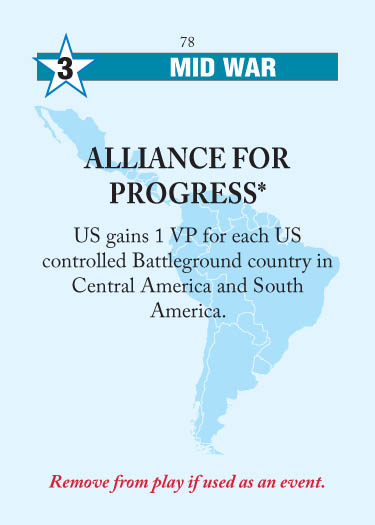
Alliance for Progress

Alliance for ProgressAlliance for Progress

1961 – 1973

Initiated by President Kennedy as a counter for growing Cuban influence in Central and South America, the Alliance for Progress was to help integrate the economies of North and Latin America. Emphases for the program included land reform, democratic reform and tax reform. By the late 60’s the United States had become fully embroiled in Vietnam and South Asia, thus aid for Latin America waned. Furthermore, few Latin American countries proved willing to undertake the required reforms. As a result, the Organization of American States disbanded its “permanent” Alliance for Progress Committee in 1973.

Time: Mid War
Side: US
Ops: 3
Removed after event: Yes

As USSR

A lot like the US OPEC, with two very crucial differences: 1) Alliance for Progress is not recurring; 2) Alliance for Progress often starts off scoring very low, but almost always scores quite high by the end of the game.

It is therefore almost always an autoplay if I draw it early in the Mid War and the US doesn’t have many battlegrounds.  But if they already control more than 2, I’ll just send it to space and hope that I draw it again later and can space it again.  (Remember that like all discards, it is better discarded on Turn 7 than Turn 6.)  If unable to space it, you can just use the Ops to break control of at least one of the US battlegrounds first.

One of the best uses of this card is as your AR1 coup.  Trigger the event after your coup, and oh, what’s this, I happened to coup away your only Latin American battleground.  How unfortunate …

As US

The reverse of the USSR analysis holds: if this can’t score you 3 or more VPs, play it for Ops and trigger it in the Late War for more.  Once it gets to 3+ VPs, I tend to prepare to trigger it lest the USSR draw it in the Late War.

Posted in Mid War, US Events | Tagged | Leave a comment

Happy Thanksgiving!

A time for all of us to focus on our own Special Relationships.  And try not to get involved in those Kitchen Debates!

Posted in Uncategorized | 5 Comments

“Ask Not What Your Country Can Do For You…”

"Ask Not What Your Country Can Do For You..."“Ask Not What Your Country Can Do For You…”

1961 – 1973

The seminal line of perhaps the most powerful inaugural address ever given by a US president, President Kennedy ushered in an era of American confidence and resolve during the Cold War. Popular with American youth, Kennedy inspired a renewed dedication for public service both with ambitious goals for government sponsored science and youth oriented public service like the Peace Corps. His call for selfless dedication to the needs of the nation reflected the passion of a restless generation of young Americans eager to make their mark upon the world.

Time: Mid War
Side: US
Ops: 3
Removed after event: Yes

As USSR

The standard way to get rid of this is to play it on the last Action Round, when hopefully the US has already taken care of all its problematic cards and has nothing left to discard.

But before you do so, you should consider whether it’s possible that a) the US knows you have it, or b) the US is still holding on to Lone Gunman or a bad scoring card.  Many experienced US players sometimes hold onto bad cards in the Mid War in hopes of a USSR Ask Not… that will save them from Lone Gunman / bad scoring cards.

The best “double agent” trick here is if the US sees you have Ask Not… in your hand (via CIA Created), assumes you’ll play it, and then you instead make a vicious AR7 play that forces a response from them using the very card they had hoped to discard.

Regardless, I rarely space this event.  I really don’t want the US to draw it in their hand, even in the Late War.  Sooner or later there’ll be a time when you can safely play this on AR7 knowing that there is not much the US can discard.

As US

An absolute life-saver for the US, and potentially one of the most powerful cards in the game depending on what you’re discarding.  When I draw this, I hold onto it from turn to turn, potentially even using the China Card to hold more bad cards, so that I can assemble together the worst possible hand to discard.  Generally this means Lone Gunman and bad scoring cards, plus some combination of unpleasant USSR events like We Will Bury You, Muslim Revolution, and OPEC.  (Yes, this means that I am holding onto President Kennedy’s inaugural speech to get rid of Lee Harvey Oswald.  Got a problem, history?)  If there’s anything I can even remotely deal with, I will try to deal with it without enlisting the services of President Kennedy.

When I do finally discard to Ask Not…, I usually also discard weak low Ops neutral events (goodbye, Summit), or sometimes even low Ops US events if they aren’t helpful (e.g., Sadat Expels Soviets if I already control Egypt).  Sometimes I’ll hold onto a high Ops starred USSR event that I don’t mind triggering, or would rather trigger than send back into the deck, but those are rare.  U-2 Incident and Cultural Revolution are perhaps the only ones that comes to mind.

If I don’t have Ask Not…, I try to keep it in my mind.  If holding Lone Gunman or a  killer scoring card, I will sometimes hold onto it until AR7 (as described above) and hope for a miracle discard.

If somehow Ask Not… ends up in the discard, remember that it is potentially a great target for SALT Negotiations and/or Star Wars if necessary.

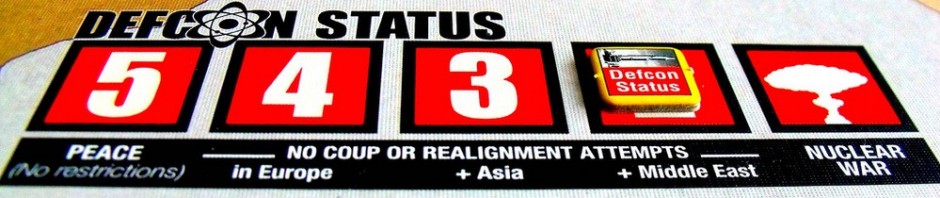
Finally, keep in mind that Ask Not is potentially a suicide card — not DEFCON suicide, but if you draw more scoring cards than you have Action Rounds available.  And even if it isn’t immediate suicide, discarding when you don’t need to at the end of a turn can sometimes force you into doing something that you would not rather do.  Exercise caution, therefore, when you are given the option of discarding with just two cards and one play left.
Posted in Mid War, US Events | Tagged | 8 Comments

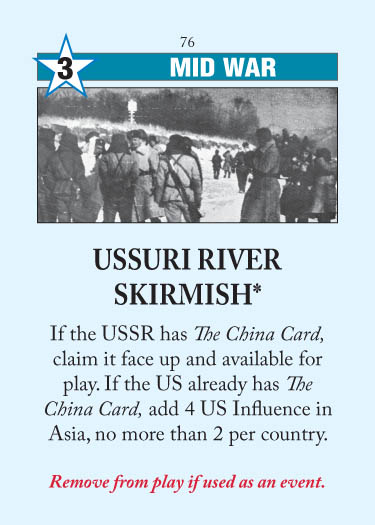
Ussuri River Skirmish

Ussuri River SkirmishUssuri River Skirmish

1969

After years of deteriorating relations and China’s first nuclear test, forces of the People’s Republic of China and the Soviet Union clashed along their long and porous border. The Ussuri and Amur Rivers’ possession remained uncertain between the two nations and were a source of friction. Following a military buildup on both sides of the border, tensions spilled over into a several sharp skirmishes. While full-blown war was avoided, the fighting led directly to the People’s Republic of China’s interest in rapidly normalizing relations with the United States.

Time: Mid War
Side: US
Ops: 3
Removed after event: Yes

As USSR

This is like an amped-up version of Nixon Plays the China Card, in that you are presented with two very unappealing choices.

There are really two options to this — either you can just fork over the China Card face-up, which is bad for all sorts of reasons, or you can give the US 4 influence, knowing you can only repair 3.  The latter is better if the US doesn’t have a face-up China Card, i.e., you played the China Card earlier in the turn.

Regardless of the path you chose, triggering this event basically means the loss of Asia or the China Card, rendering you very vulnerable to DEFCON suicide.  As a result I almost always send it to space.

As US

The main appeal of Ussuri River Skirmish is that Asia is very difficult to flip.  This event coupled with the China Card is therefore one of the few ways to swing the region in your favor in the Mid War if it has yet to be scored.  5 Ops is enough to flip any uncontrolled 3-stability country or any non-overcontrolled 2-stability country.  I usually target Thailand first, then Pakistan/North Korea/South Korea, depending on which I control.

Although Ussuri is a powerful event, it’s also easily parried with a 4 Ops card.  Therefore, you want to time Ussuri so that the USSR either can’t respond to it (late in the turn, when he has used up his high Ops cards), or must hand over the initiative in order to do so (i.e., headlining Ussuri or playing it on AR7). It’s even better when you can headline Ussuri River Skirmish on top of an AR7 play that already de-stabilized Asia, because then the damage is hopefully irreparable in a single Action Round.

You can also just play Ussuri for the China card, which I often do if I need to hold an extra card this turn (and would therefore like to play the China Card), take away a safety outlet for the USSR, or if Asia has already been scored.

Posted in Mid War, US Events | Tagged | 4 Comments

Liberation Theology

Liberation TheologyLiberation Theology

1969 – ?

An outgrowth of the Second Vatican Council, liberation theology stresses Jesus Christ as liberator. The theological strain that sustained this outlook originated in Latin America and flourished there, particularly with the Jesuit order. While never embraced by Pope John Paul II due to its Marxist undercurrents, liberation theology remains very popular with individual priests and the laity in the third world. Its emphasis on social justice and its critique of capitalist excess has, however, been incorporated into broader Church doctrine.

Time: Mid War
Side: USSR
Ops: 2
Removed after event: No

As USSR

A lifesaver in the Mid War by getting you into Central America. I almost always play this for the event, unless Central America Scoring has been triggered unusually early.  It is a strong headline that often breaks US control of multiple battlegrounds and opens the door for a highly advantageous Central America Scoring (like Socialist Governments and Europe).

It is often used to get to Mexico, otherwise inaccessible as Fidel gets you Cuba and Panama can be couped.  Beware being realigned out of Mexico, however, especially if you lose Guatemala.  You can also use it to grab a lot of non-battlegrounds to cement your or deny their Domination.

As US

One of the few genuinely unpleasant Mid War USSR events.  I usually send this to space, particularly if the USSR has no access to Central America.  Even if they do, it takes 3 Ops to repair the damage, and so it’s usually just easier to send it to space rather than preemptively fortify the region.  In addition, Central America Scoring is often decided by non-battlegrounds, and Liberation Theology can very inconveniently take a whole bunch of non-battlegrounds all at once.

One of the main ways to defuse this card is to make sure to play into Mexico.  Most US players get complacent about their southern border, and end up losing it to Liberation Theology before they had a chance to contest it.  Yes, you can realign the USSR out, but I’d rather not have to worry about it in the first place.

Posted in Mid War, USSR Events | Tagged | 2 Comments

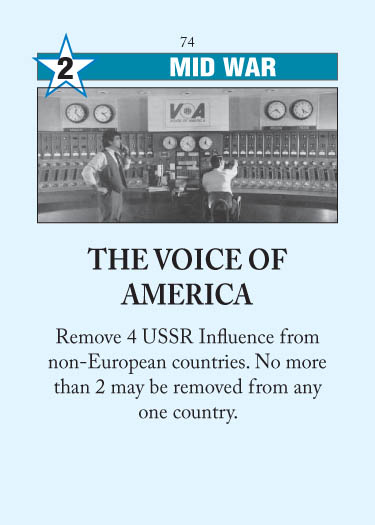
The Voice of America

The Voice of AmericaThe Voice of America

1947

Formed in 1942 under the War Information Office, the VOA initially broadcast war news into Nazi occupied Europe. In 1947, it altered its mission to begin broadcasting into the Soviet Union. Voice of America has become one of the best known international broadcast efforts in the world. It provided a powerful outside link to the state-controlled media systems of the Eastern Bloc. Together with Radio Free Europe and Radio Free Asia, Voice of America became a hallmark of US public diplomacy efforts during the Cold War.

Time: Mid War
Side: US
Ops: 2
Removed after event: No

As USSR

The Voice of America is a wholly unplayable event for the USSR.  It ranks alongside DEFCON suicide cards in terms of Space Race priority; at least with Duck and Cover, you could headline it or play it on AR1 when DEFCON is still at 3.  The Voice of America is never safe for the USSR to play and never mitigatable, not even if boosted with Brezhnev Doctrine.

The event is at its worst when you just made inroads into a region and VOA eliminates you entirely: for instance, it is a perfect antidote to a Mid War De-Stalinization.  It is therefore imperative for you to try to establish footholds of 5 influence (or one country with 3 influence) whenever and wherever you fear VOA.  Losing 4 influence is tough but at least salvageable; losing access entirely can decide the game.  This means, for instance, that you cannot just rely on 2 Venezuela / 2 Brazil as your sole foothold in South America, or 1 Angola / 1 Zaire / 1 Nigeria as your sole foothold in Africa.

As US

As indicated above, The Voice of America is best when you can use it to knock the USSR out of a region entirely.  Sometimes such a situation will naturally fall into your lap; other times, you can manufacture such situations with an eye towards VOA as the knockout blow.  A couple of strategic coups and realignments can reduce the USSR down to what he thinks is a last stand, before VOA takes him out by the knees.

If you can’t eliminate access, then the next best effect of VOA is in countries where you have influence and can immediately control or threaten to immediately control.  It is a good way to simultaneously threaten two regions at once and force the USSR to choose between them.

VOA is one of the best AR7 plays.  In particular, VOA is at its most devastating on Turn 10 AR7.  If I draw VOA in the Late War, I will do everything possible to make sure that I can hold it until then for a crippling final blow.

It is somewhat athematic that VOA cannot affect Europe, but I suppose the event is strong enough without it being a quasi-East European Unrest as well.

Posted in Mid War, US Events | Tagged | 7 Comments

Shuttle Diplomacy

Shuttle DiplomacyShuttle Diplomacy

1973

Personalized diplomacy that uses advances in transportation and communications, Shuttle Diplomacy was a hallmark of Henry Kissinger’s term as Secretary of State. Most famously, it was utilized to broker a cease-fire between Israel and Egypt after the Yom Kippur War. By acting as personal go-between for the Egyptians and Israelis, Kissinger maintained the pivotal role in discussions and minimized Soviet influence over the negotiation process. Kissinger utilized a similar style when dealing with the normalization of relations between the United States and the People’s Republic of China.

Time: Mid War
Side: US
Ops: 3
Removed after event: No

As USSR

This event functions a lot like a US Flower Power, in that the USSR will usually just bite the bullet and trigger it, but the US will rarely find a reason to.  Unlike Flower Power, however, Shuttle Diplomacy is guaranteed to have an effect — at a minimum, it will cost you 1 VP.  Because both the Middle East and Asia have an even number of battlegrounds, nothing will usually happen if the USSR already has Domination and a 4-2 advantage in battlegrounds.  But if you are tied 3-3 on battlegrounds, then Shuttle Diplomacy will often give the US Domination (usually the worst case scenario).

In summary, the possible outcomes for Shuttle Diplomacy are:

Middle East Asia
Does not affect scoring bonuses 1 VP 1 VP
Denies USSR Presence 4 VP 4 VP
Affects Domination 3 VP 5 VP
Denies USSR Control 3 VP 3 VP

I’m therefore OK with playing Shuttle Diplomacy for the Ops.  It is pretty far down the list in terms of Space Race priority unless I know for sure that it will affect the next Domination.  Usually at least one of the two regions should only be a 1VP swing.

Generally, you would rather Shuttle Diplomacy get triggered on the Middle East.  Not only is the potential Domination swing smaller, it is also more likely to have no effect on Domination in the first place.

As US

Like the USSR and Flower Power, it’s hard to find a reason for the US to play Shuttle Diplomacy for the event.  3 Ops are immediately useful, whereas the event’s benefit is speculative and uncertain unless you also have the scoring card in hand.  It is most effective when the battlegrounds are tied 3-3, but even then, depending on non-battlegrounds, it still may not affect Domination.  And even if it affects Domination this turn, it may no longer by the time either of the scoring cards is played.

Rules clarifications:

  • The US gets to choose which battleground to deny the USSR.  This is relevant only in the extraordinarily rare circumstance where the USSR controls Japan.
  • The USSR can lose Presence as a result of Shuttle Diplomacy, if they only control one country (which happens to be a battleground).
  • The US cannot gain Control as a result of Shuttle Diplomacy.
Posted in Mid War, US Events | Tagged | 16 Comments