Allende

AllendeAllende

1970 – 1973

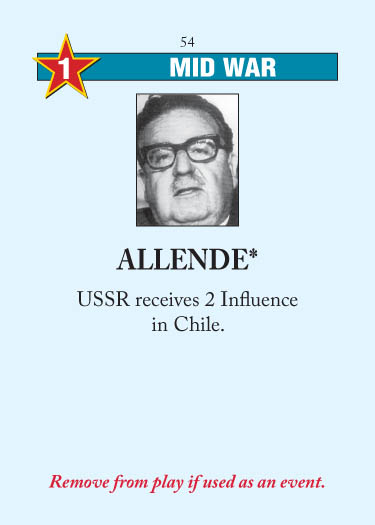
A physician, Salvador Allende was popularly elected in Chile to lead that nation’s first socialist government. Allende moved quickly to socialize copper production— Chile’s largest export commodity. The mines were largely held by two US companies, Kennecott and Anaconda. Relations with the US soon turned frosty, and the CIA supported an attempted coup in 1970. It failed. However, as the West applied harsh economic sanctions, the Allende regime floundered in its second and third years. In 1973, the military, led by Augusto Pinochet, deposed Allende with a bloody assault on the presidential palace. Allende took his own life.

Time: Mid War
Side: USSR
Ops: 1
Removed after event: Yes

As USSR

If you haven’t made it into South America, then Allende is great, obviously, but beware getting wiped out by realignment.

If you’re already in South America, then Allende is rarely helpful unless you really need 2 influence in Chile right now.  Better to just let it come back in the Late War.

When taking over South America, I usually take over Chile last, because maybe the US has to play Allende for me.  But as soon as I suspect the scoring card is coming, I take Chile rather than miss out on Control or Domination because I was too cheap to spend two influence.

Similarly, if I need to establish access to South America via coup, I usually coup Venezuela/Brazil, because I might eventually gain access to Chile via Allende and Argentina via The Iron Lady.

As US

The easiest way of dealing with Allende is to overcontrol Chile first and then use Allende’s 1 Op to repair the damage.  If the USSR doesn’t have access into South America, then the best way of dealing with Allende is usually via realignment: take Peru and Argentina, then realign away the two USSR influence.

The worst situation is when neither of you are in South America: you’ll just have to hold Allende for a long time.  If forced to play it, your best bet is to still try to realign Chile, with 1/6 odds of knocking the USSR out entirely.

Posted in Mid War, USSR Events | Tagged | 6 Comments

South African Unrest

South African UnrestSouth African Unrest

1964 – 1994

The racist, minority government of South Africa began to be challenged by the African National Congress with Soviet and Cuban assistance from bases in Tanzania and Zambia and other “front-line” states. The era of peaceful resistance formally ended with the massacres in Sharpeville and Langa. For its part, South Africa sought to destabilize its neighbors, and undertook an invasion of Namibia, while also supporting UNITA in Angola and FRELIMO in Mozambique. However, increasing black population, more powerful black trade unions, and hostility from other western nations eventually placed South Africa on the defensive. While the Reagan Administration pursued a policy of “constructive engagement” with the Apartheid government, it remained a controversial proposition. Ultimately, the collapse of the eastern bloc made P.W. Botha’s release of Nelson Mandela inevitable.

Time: Mid War
Side: USSR
Ops: 2
Removed after event: No

As USSR

Practically speaking, South African Unrest serves much the same purposes as Portuguese Empire Crumbles, though it’s a tiny bit better because its influence goes into more important countries and is recurring.  I will still usually play it for Ops, unless the 2 influence in a neighbor gives me the chance to flip Angola.  Practically speaking, 1 in South Africa is not a huge deal, and isn’t going to let you flip a controlled South Africa.  But if the countries are open to Ops, or if I haven’t been able to get into the region, then South African Unrest is a godsend.

I almost always choose 1 in South Africa and 2 in a neighbor.  For one, it’s 50% more influence, and no longer counterable with the card’s Ops.  For two, Angola and Botswana are both lucrative targets, and 2 influence in Angola can sometimes flip the country.  Only if I already control Angola/Botswana will I consider putting both influence into South Africa.

Despite a possible interpretation of the event’s text otherwise, you cannot use this for 1 in Angola and 1 in Botswana: it has to be 1 in South Africa plus 2 in Angola or 2 in Botswana.

A previous version of this card implied you could not “split up” the influence, that is, place 1 in Angola and 1 in Botswana, but the current wording and the v5 FAQ indicates that you can.

As US

Much more annoying to deal with than Portuguese Empire Crumbles, since you can’t actually repair 3 influence with 2 Ops.  If the USSR chooses 2 in South Africa, then it’s no big deal, but 2 into Botswana and/or Angola is more annoying, especially if you want to use your Ops before the event but don’t know which one the USSR will play into.

That having been said, it’s a lot less painful than some other USSR events, so I usually just suck it up and play it.  But if I have nothing more urgent to space, then this is certainly going to space instead of being (at best) an empty Action Round.

Posted in Mid War, USSR Events | Tagged | 11 Comments

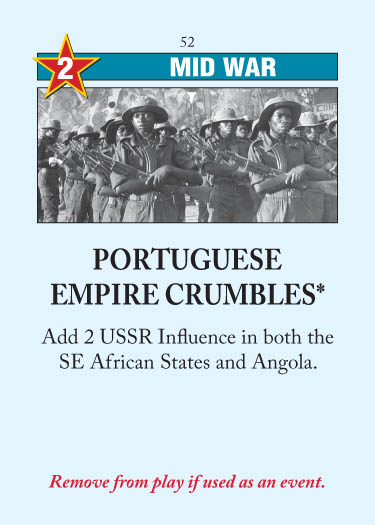
Portuguese Empire Crumbles

Portuguese Empire CrumblesPortuguese Empire Crumbles

1974

Portugal was the last European power to abandon her major colonial possessions in Africa. While admitted to NATO, Portugal was ruled by dictatorship under Antonio Salazar, who felt that colonial possessions would preserve Portugal’s place in the community of nations. Nevertheless, the repression of nationalist insurgencies brought criticism both from newly independent nations, as well as Portugal’s NATO allies. Finally, with a democratic government in place, Portugal renounced its claims. Shortly thereafter, Portugal’s former colonies of Angola and Mozambique descended into civil war and became major flash points for East and West on the continent of Africa.

Time: Mid War
Side: USSR
Ops: 2
Removed after event: Yes

As USSR

If you hadn’t drawn De-Stalinization or Decolonization, then Portuguese Empire Crumbles and South African Unrest are your primary non-coup ways to get into Africa.  The event can also sometimes flip Angola, but most US players will overcontrol 1-stability battlegrounds anyway (so you can’t just flip it with a 3 Ops).  And if you’re under Red Purge, the event’s text suddenly looks a lot better when the alternative is just 1 Op.

Outside of these situations I rarely play Portuguese Empire Crumbles for the event.  It’s the Angola influence that really matters, and if you needed 2 influence there you could just use the card’s Ops and keep the event in the deck.

As US

Drawing Portuguese Empire Crumbles is not much of a problem.  The 2 Ops can easily be used to repair Angola, and who really cares about SE African States.  If the USSR isn’t in Africa, then I will consider spacing it, but if that’s the case then you should also be able to use the card’s Ops and control of Zaire/South Africa/Botswana to realign the Angola influence out.

Posted in Mid War, USSR Events | Tagged | 10 Comments

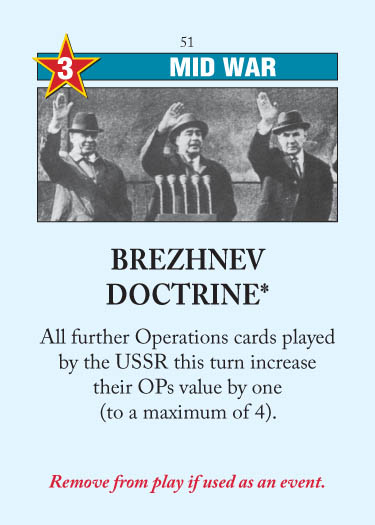
Brezhnev Doctrine

Brezhnev DoctrineBrezhnev Doctrine

1968

Announced to a crowd of Polish workers by Brezhnev himself, the Brezhnev Doctrine clarified the de facto policy of the Soviet Union, the Prague Spring. Namely, current socialist countries would not be allowed to abandon socialism or adopt a position of neutrality. The doctrine contributed to the Soviets’ miscalculation of world reaction to their invasion of Afghanistan. They looked upon the invasion as the mere application of this well-understood doctrine.

Time: Mid War
Side: USSR
Ops: 3
Removed after event: Yes

As USSR

A superb USSR Mid War headline at a time when there is usually very little good news for the USSR.  Compared to Containment, it has two disadvantages: first, it comes at a time when there is less opportunity for Ops on the board, and second, if drawn by the US, it has zero effect instead of a minimal effect.

But its great advantage over Containment is that it allows the USSR to deal with the irritating Mid War US 1 Op cards: OAS Founded, Panama Canal Returned, Kitchen Debates, and Sadat Expels Soviets.  (Sometimes CIA Created, if you are unlucky.)  It makes those events eligible for the Space Race and alternatively makes it much easier to mitigate their effects.  (The latter is also true for Ussuri River Skirmish.)

Occasionally I will hold this from turn to turn if my hand is not particularly suited for Brezhnev Doctrine (e.g., many scoring cards or no US events).  But I will always headline it sooner or later.

As US

Play it on the last Action Round and be glad you drew it.

Posted in Mid War, USSR Events | Tagged | 2 Comments

We Will Bury You

We Will Bury YouWe Will Bury You

1956

Perhaps the most famous quote of the entire Cold War, Soviet Premier Nikita Khrushchev uttered this immortal line while addressing Western ambassadors at a reception in Moscow. With these words Khrushchev announced a period during which he would probe the West for weakness and opportunity. The Berlin Crisis exemplified this expansionist policy.

Time: Mid War
Side: USSR
Ops: 4
Removed after event: Yes

As USSR

You often see this played for Ops, because 4 Ops is a lot of Ops, and the USSR ordinarily does not want to drop DEFCON.  If you really wanted to drop DEFCON to 2, you can usually just use the card for a nice coup.

However, there are certain situations where you want to drop DEFCON in the headline phase.  Perhaps the US made an AR7 play and you’d prefer your AR1 to be spent doing something other than couping.  Perhaps you think the US will drop DEFCON in their headline and a DEFCON victory is one of the few ways you can win the game.

And of course, sometimes you just want 3 VPs.  It’s a ton of VPs, and towards the end of the Mid War, if you can lower DEFCON, 4 Ops for 3 VPs is a decent trade. Indeed, what usually pushes me to headline it is the combination of the VPs plus the chance for an instant DEFCON win.

The 3VPs take precedence over any card played by the US, so if you play We Will Bury You on at -17VP, and the US plays a scoring card worth +10VP on its next AR, We Will Bury You goes first and ends the game before the US scoring card is tabulated.

Note that you can almost always headline this safely, since it is a 4 Ops event, meaning the only possible US headline that would take precedence and drop DEFCON is Soviets Shoot Down KAL-007.

As US

A DEFCON suicide card almost all of the time, and even when it isn’t automatic suicide, 3VP is a lot to give up.  I almost always send this to space.  You could theoretically use this as a way to drop DEFCON in the headline if you have UN Intervention in your hand, but you’d probably prefer to just use UN Intervention with this for the 4 Ops.

Posted in Mid War, USSR Events | Tagged | 22 Comments

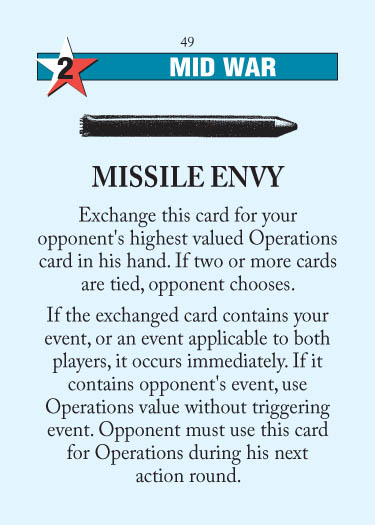
Missile Envy

Missile EnvyMissile Envy

1984

A term coined by Dr. Helen Caldicott, it reflects the general feminist critique that the Cold War was driven by male ego with very Freudian undercurrents. When one examines the terminology of “deep penetration” and “multiple reentry” one wonders if she had a point. Caldicott went on to found Physicians for Social Responsibility, and her book became a rallying point within the anti-nuclear movement.

Time: Mid War
Side: Neutral
Ops: 2
Removed after event: No

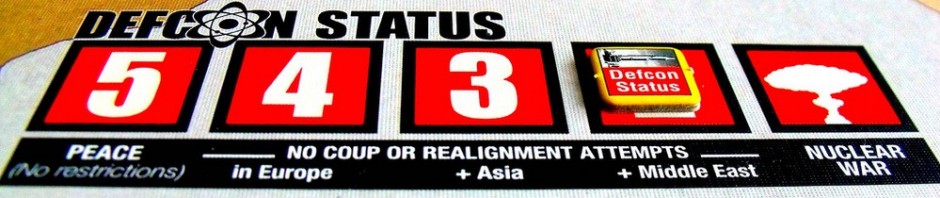
Yet another excellent Mid War neutral event, though its capacity for DEFCON suicide keeps it a tier below ABM Treaty / Junta / Brush War / SALT Negotiations.  When I draw it, I will usually headline it whenever possible.

There are four possible outcomes with Missile Envy:

1. You are forced to trigger an unfavorable event.

This is the worst case scenario with Missile Envy.  For starters, DEFCON suicide is eminently possible if DEFCON is at 2 — but even when it is at 3 in the headline, you can still lose if your opponent’s headline degrades DEFCON ahead of Missile Envy. For example, as USSR, you might pull We Will Bury You when the US headlined Grain Sales to Soviets.  Alternatively, as US, you might pull Duck & Cover or Soviets Shoot Down KAL-007 when the USSR headlined We Will Bury You.  (It is also conceivable, though staggeringly unlikely, that Missile Envy pulls Olympic Games or Summit, both of which can also degrade DEFCON.)

Aside from DEFCON suicide, it is also possible (though extremely rare) that the event you pull with Missile Envy is harmful to you.  For instance, Nuclear Test Ban might raise DEFCON at a point when you want to lower it.  In general, as long as either We Will Bury You (for USSR) or Duck and Cover/Soviets Shoot Down KAL-007 (for US) are out of the game, then I don’t worry about the possibility of losing the game via Missile Envy, especially in the headline, and especially if I’m the US (since the USSR rarely lowers DEFCON in headline).

2. You are forced to trigger a meaningless event.

The second-worst possible outcome.  More commonly happens to the US: US/Japan Defense Pact and NATO are the best examples.  Arms Race is often a wash as well.  This rarely happens to the USSR as its high Ops events are almost always useful.

Even in this situation, I still consider Missile Envy a net plus, since you’ve eliminated a high Ops card from your opponent’s hand.

3. You trigger a event good for you.

Generally the second-best possible outcome, depending on how good the event is.  Most of the really good events have high Ops, and so the possibilities range from Red Scare/Purge, ABM Treaty, Muslim Revolution, or Marshall Plan, to Brezhnev Doctrine, Bear Trap, Ussuri River Skirmish, or OPEC.  Of course, maybe you trigger something that is only speculatively helpful, like Flower Power, but in general, your high Ops events are good to trigger in exchange for 2 Ops.

4. You get to conduct Operations.

I consider this generally the best possible outcome.  Not only can you conduct operations in the headline, but you’ve also eliminated a high Ops event (a potentially powerful opponent’s event) from your opponent’s hand.  Taking Muslim Revolution and turning it into a no-strings-attached 4 Ops US coup is a gamechanger.

[The above analysis, incidentally, illustrates that I usually try to hand over their event or a neutral event rather than my own event.]

The second half of Missile Envy is usually just as strong: the fact that you force your opponent into a 2 Ops play on AR1 is very exploitable.  For example, as US, when you headline Missile Envy, the USSR is now forced to either coup with a 2 Ops or let you coup. Not a big deal if he’s couping Zaire, but a real discomfort if he was counting on a big coup to get into South America.  Conversely, the USSR can headline Missile Envy then make an AR1 play for a battleground knowing that the US response can only be 2 Ops.

In general I do not use Missile Envy during the middle of the turn, first because DEFCON is already 2 (furthering the risk of nuclear suicide), and second because the opponent will have already used high Ops cards, and I’m no longer assured of a 3 or 4 Ops card.

Missile Envy may combo well if you know your opponent’s hand already (i.e., you headlined CIA Created or Lone Gunman), since you can have an idea of what you will be getting.
Posted in Mid War, Neutral Events | Tagged | 38 Comments

Kitchen Debates

Kitchen DebatesKitchen Debates

1959

During a time of increased tensions following the successful launch of Sputnik, then Vice President Richard Nixon took a good-will trip to Russia. What followed was a sometimes playful, sometimes pointed public exchange between Nixon and Nikita Khrushchev throughout his stay in Moscow. The exchange is known as the Kitchen Debate, for a particularly sharp exchange in front of a US model home’s display of a GE electric kitchen. Nixon furthered his domestic political ambitions with a seeming jab at Khrushchev’s chest, reaffirming his anti-communist credentials at home.

Time: Mid War
Side: US
Ops: 1
Removed after event: Yes

As USSR

Kitchen Debates incentivizes you to take battlegrounds, but you should already be incentivized to do that anyway.  There’s not much to say about this card — if the US is ahead on battlegrounds, you lose 2VP; if the US isn’t, then you don’t.

I find Kitchen Debates to be more helpful as a rough barometer of how I’m doing.  Start worrying if the US has more battlegrounds and is ahead on VP.

Note that this card is not removed from the deck if triggered while the prerequisite is not met.

As US

1 Op is usually not very helpful, and 2VP often is.  Unless you have some immediate use for the 1 Op, I prefer the 2VPs and the opportunity to poke my opponent in the chest.

Posted in Mid War, US Events | Tagged | 12 Comments

Junta

JuntaJunta

1945– ?

In Spanish, the term Junta means “coming together.” In a Cold War context, it normally refers to the coming together of right wing military cliques to oust an existing government and replace it with a military dictatorship. Juntas were so common in Latin America throughout the period that they became a nearly ritualized affair. More frequently than not, military juntas enjoyed the tacit blessing of the U.S. government as they looked to check leftist elements in Central and South America. Notable juntas include the military dictatorships that ruled Argentina from 1976 to 1983 and Guatemala from 1954 to 1984.

Time: Mid War
Side: Neutral
Ops: 2
Removed after event: No

One of the Big Three Mid War neutral events, along with ABM Treaty and Brush War, and one of the strongest events in the game.  Junta’s primary drawbacks are that it is region-restricted, it doesn’t provide Mil Ops, and it is less likely than the others to flip a battleground directly (since your coup odds are much lower, and you can’t coup battlegrounds with it at DEFCON 2).  But it is the only one of the three that is guaranteed to give you influence in a region.  In addition, it does two things at once, so not only does it let you realign, it will also help you set up a good realign opportunity.

Junta is a more common headline than ABM Treaty / Brush War, mainly because it’s the only one of the three that can degrade DEFCON.  The choice of coup or realign gives Junta the best of both worlds: stealing the headline coup is a great option, but sometimes realignment is the safer play.  This is especially true for USSR, who can headline it, realign, and then coup on AR1 for Mil Ops and perhaps also a bigger coup.

After DEFCON drops to 2, Junta is almost exclusively used to set up a critical realign.  If you control Brazil and the US controls Venezuela, you can use Junta to drop 2 influence in Colombia and immediately start realigning, rather than giving the US an opportunity to coup Colombia to defend itself.  Common realigns include Costa Rica/Colombia realigning Panama, Colombia/Brazil realigning Venezuela, Venezuela/Uruguay realigning Brazil, Argentina/Peru realigning Chile, and for the US, realigning Mexico or Cuba with Guatemala or Nicaragua, respectively.

Because it guarantees influence placement, Junta is often a critical card to draw when neither side has made any inroads into South America.  Even if you are forced to waste the second half of the event, it may be worth it just to get into the region.

Some common rules questions:

  • Do both influence have to go into the same country?
    • Yes.
  • Does the country you realign/coup have to be the same country as the country you placed influence in?
    • No.  You also don’t have to realign the same country twice.
  • Is Junta affected by Red Scare/Purge, Containment, and Brezhnev Doctrine?
    • Yes.
  • Does a Junta battleground coup degrade DEFCON?
    • Yes.
  • Then what does “free coup” mean?
    • It means it does not give Mil Ops, and more generally, is not subject to DEFCON geographical restrictions.  (Which doesn’t matter in the case of Junta, since DEFCON 2 does not geographically prevent a coup in Central or South America, but it does matter for Tear Down This Wall.)
Posted in Mid War, Neutral Events | Tagged | 12 Comments

How I Learned to Stop Worrying

How I Learned to Stop WorryingHow I Learned to Stop Worrying

1964

As the reality of nuclear holocaust became accepted by the public, fatalism about its inevitability also took hold. The landmark black comedy, Dr. Strangelove, captured this new mood. However, such attitudes are hardly unique. Similar fatalism about mankind’s ultimate destiny can be found throughout literature of the time and sparked a whole sub-genre of science fiction, the post-nuclear-holocaust dime novel filled with atomic mutants and vague remnants of contemporary civilization. Ironically, the pessimism that is reflected in these works may have aided the possibility of nuclear war by making such an act “thinkable.”

Time: Mid War
Side: Neutral
Ops: 2
Removed after event: Yes

A straightforward way to manipulate DEFCON, so it works in all the situations you’d expect: DEFCON-suicide cards, situations where your opponent can’t coup due to Quagmire/Bear Trap or Cuban Missile Crisis, etc.

Like other DEFCON degraders, it’s also useful as a headline trap, since if your opponent’s headline degrades DEFCON and is subsequent to yours, you instantly win.  (One advantage HILTSW holds over headlining other DEFCON degraders is that it can’t backfire if your opponent also tries to lower DEFCON in the headline.)

The Mil Ops is what really sets this card apart: it means you can headline it to prevent battleground coups, but also earn your Mil Ops VPs at the end of the turn.  In addition, it gives the US a little trick on the last Action Round: use How I Learned to Stop Worrying to set DEFCON to 5, meaning instead of losing 2 VP to Mil Ops requirements, you can force the USSR to lose up to 3 VP to Mil Ops.

So, like most Mid War cards, this one tilts slightly to the US, who often needs both DEFCON at 2 and Mil Ops more than the USSR does.  But the USSR can get good value out of it as a DEFCON raiser: if they headline the card, they might be able to raise DEFCON to 4 or 5 and be able to coup Asia / realign Europe on AR1.

Posted in Mid War, Neutral Events | Tagged | 18 Comments

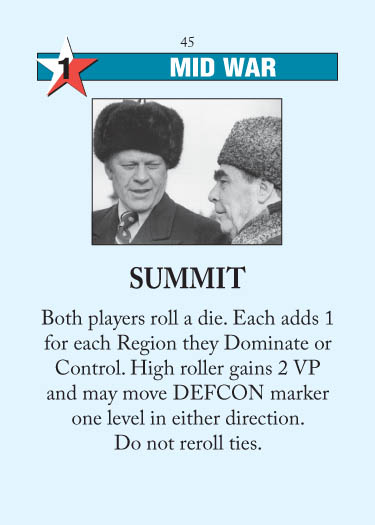
Summit

SummitSummit

1959, 1961, 1972, 1973, 1974, 1979, 1985, 1986, 1987, 1988, 1989

Summits between the leadership of the superpowers became major implements of public diplomacy from the mid to late Cold War. Success was measured in terms of agenda items secured, treaties signed, and who was tougher on whom. As in an international boxing match, non-aligned countries watched from the sidelines trying to discern which power was in the ascendant. Virtually all major arms control agreements were either initiated or concluded at a summit. In that sense, they were an important tool for sizing up relative intentions, and ensuring the Cold War did not become hot.

Time: Mid War
Side: Neutral
Ops: 1
Removed after event: No

Summit is one of the weakest cards in the game to draw.  For starters, it’s a 1 Op card: Nuclear Test Ban might be the worst event relative to its Ops, but no one is ever unhappy to draw it.

Worse, like Olympic Games, it has the strong possibility of losing you the game at DEFCON 2.  Although it is not a guaranteed DEFCON suicide card, you would be foolhardy indeed to play this at DEFCON 2 unless you had a massive lead in regions.

More commonly, because of its very low Ops value, you might headline it if there’s nothing else worth headlining and you’d rather conserve your Ops.  Alternatively, if you are absolutely desperate for VPs, Summit offers you the grim choice of a chance at 2VPs or nuclear annihilation.

Posted in Mid War, Neutral Events | Tagged | 20 Comments